

How to See the Prado in One Full Day: Room-by-Room Itinerary
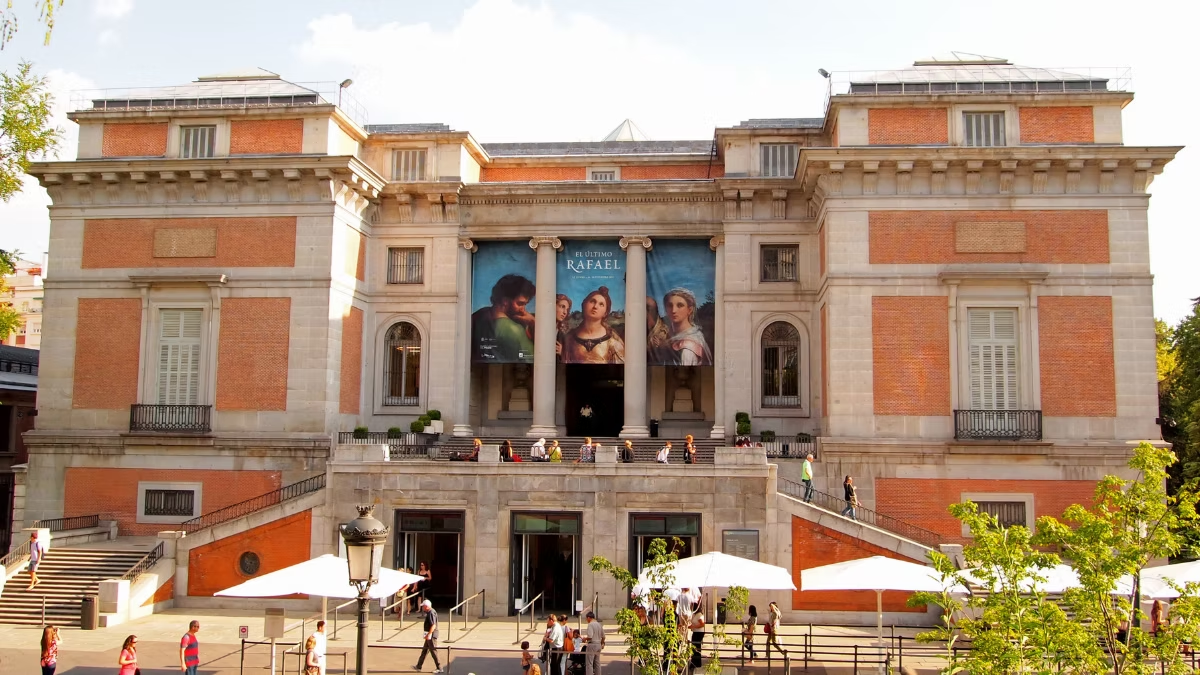
A full day at the Prado Museum — approximately 5 to 6 hours of actual looking time — allows you to cover both the essential masterpieces and significant portions of the broader collection. This includes the Spanish Golden Age, the full Flemish and Italian collections, El Greco, Goya’s complete works in the museum, the sculpture galleries, and any current temporary exhibitions. Allow for rest breaks and do not attempt to see every room — the Prado cannot be exhausted in a single day.
A full day at the Prado is one of the most rewarding ways to spend time in Madrid. It is also one that most visitors do not plan properly — they arrive with the intention of seeing everything, exhaust themselves by early afternoon, and leave feeling they have both seen too much and not enough.
The answer is not to see more rooms. It is to see the right rooms, at the right pace, with planned rest stops at the right times. This itinerary is built around what a serious, curious visitor can absorb in approximately 5–6 hours, divided into two clear sessions with a break in the middle.
Top Tickets
Planning Your Full Day: The Basics
Arrive at 10:00 AM — the moment the museum opens. The first 90 minutes are the quietest of the day, and the most important rooms (including Las Meninas in Room 12) are at their most accessible.
Book a timed-entry ticket in advance. Even for a full-day visit, securing a 10:00 AM entry slot requires advance booking during peak season. The Prado entry ticket with free cancellation is the right choice.
Bring water — the museum allows water in the galleries. Long visits in a large building are physically demanding.
Plan two sessions with a break. A morning session (10:00 AM – 1:00 PM), a lunch break outside the museum (1:00 PM – 2:00 PM), and an afternoon session (2:00 PM – 5:00 PM) is the most effective structure. The museum café is available for a mid-session rest if needed.
Carry a floor map — collect one at the entrance and refer to it constantly. The Prado’s layout is genuinely complex.
Morning Session (10:00 AM – 1:00 PM): The Masterpieces
Spend the morning on the works that most visitors prioritise — the rooms that should not be rushed, where your freshest attention is most valuable.
10:00 AM — Las Meninas (Room 12) | 20–25 minutes
Enter via Puerta de Velázquez. Move directly to Room 12. The room will be quiet at opening — this is your window to see Las Meninas without the press of visitors that accumulates from 11:00 AM onwards.
Stand at the back first. Then approach. Then look at the mirror. Then step to the side to observe the painting at an angle — the spatial depth becomes even more apparent. Then read the room number labels to identify the other works in the surrounding rooms.
10:25 AM — Velázquez: The Full Collection — Rooms 10–16 | 30–35 minutes
These rooms contain the full breadth of Velázquez’s work at the Prado — not just Las Meninas but Las Hilanderas (The Spinners, Room 16), The Surrender of Breda (Room 14), the equestrian portraits, and the extraordinary portraits of court dwarfs and jesters that are among the most psychologically complex works in the collection.
Do not rush through in order to reach the “better” rooms — these are the better rooms. The dwarf portraits (Don Sebastián de Morra, Francisco Lezcano) are as remarkable as anything in the museum.
11:00 AM — Italian Renaissance: Titian, Raphael, Tintoretto — Rooms 24–27 and Room 49 | 30 minutes
Titian’s collection at the Prado is the finest outside Venice. Charles V at Mühlberg (Room 27) is the most famous but The Bacchanal of the Andrians and the Venus paintings show the full range of his mythological work. Room 49 contains Raphael’s The Holy Family of the Oak and The Cardinal — essential stops for anyone with serious interest in the High Renaissance.
11:30 AM — Rubens and the Flemish Baroque — Rooms 28–32 | 25 minutes
The Three Graces (Room 29) is the centrepiece, but the surrounding rooms contain major Rubens mythological canvases, Van Dyck portraits, and Jan Brueghel landscapes. The Flemish collection at the Prado is one of the finest outside Antwerp and Brussels.
11:55 AM — El Greco — Rooms 8B–10B | 20 minutes
El Greco’s rooms on the ground floor reward a slightly longer stop than the 2-hour route allows. The Nobleman with His Hand on His Chest, The Annunciation, and the extraordinary Knight with His Hand on His Breast together demonstrate the full register of El Greco’s achievement — from intimate portrait to visionary religious painting.
12:15 PM — The Garden of Earthly Delights (Room 66) | 20–25 minutes
Bosch in the morning, while your attention is still fresh. Allocate 20 minutes minimum and work through each panel systematically. The detail in the central panel is genuinely inexhaustible — come with the intention of finding three or four specific details you have not noticed before.
12:40 PM — Goya’s Black Paintings — Rooms 35–38 | 20 minutes
End the morning session in the most psychologically intense rooms in the museum. The Black Paintings demand sustained, undistracted attention. After a morning of extraordinary painting, these rooms provide a final, dramatic counterpoint.
1:00 PM — Exit for lunch break
Lunch Break (1:00 PM – 2:00 PM)
Leave the museum and eat nearby. The Huertas neighbourhood (5 minutes east) and the streets around Plaza Santa Ana offer a wide range of restaurants and tapas bars. The change of environment and the physical act of sitting, eating, and talking about what you have seen helps consolidate the morning’s experience and refreshes your attention for the afternoon.
Afternoon Session (2:00 PM – 5:00 PM): The Deeper Collection
The afternoon session is for the works and rooms that a 2-hour visit cannot reach — the deeper layers of the collection that make the Prado more than a highlights museum.
2:00 PM — Goya’s Early Works, Majas, and Portraits — Rooms 30–36 | 40 minutes
The Black Paintings are Goya’s most famous works, but the full arc of his career is visible in the adjacent rooms. The tapestry cartoons (Room 30) — bright, playful, full of popular Madrid life — are the work of a young artist with every reason for optimism. The Majas (Room 36) are the works that caused a scandal. The later portraits show the progression toward the psychological darkness of the final paintings.
2:40 PM — Italian Baroque: Caravaggio, Ribera, Artemisia Gentileschi — Rooms 2–7 | 35 minutes
The Prado’s Italian Baroque collection is exceptional and routinely overlooked. Ribera’s paintings — raw, physical, technically astonishing — are discovered by visitors who reach the ground floor’s less-visited rooms. Caravaggio’s David with the Head of Goliath and works by Artemisia Gentileschi reward serious attention. These are the rooms where the Prado stops being a highlights museum and becomes a serious research collection.
3:15 PM — Zurbarán and Early Spanish Painting — Rooms 16A–18A | 20 minutes
Francisco de Zurbarán’s intensely physical religious paintings — objects with the weight and texture of stone rather than canvas — occupy rooms that most visitors pass through quickly. They are a significant part of the Spanish Golden Age and deserve more attention than they typically receive.
3:35 PM — Northern European Masters: Dürer, Memling, Rogier van der Weyden — Rooms 54–56B | 25 minutes
Albrecht Dürer’s self-portrait at the Prado (Room 55B) is one of the most significant paintings in the collection — a revolutionary image of the artist as a Christ-like figure of divine creativity, painted when Dürer was 28 years old. Memling and Rogier van der Weyden in the adjacent rooms show the Flemish tradition before Rubens.
4:00 PM — The Sculpture Collection — Ground Floor, Villanueva Building | 20 minutes
The most consistently overlooked section of the Prado. The ground floor contains Roman sculpture, Renaissance bronzes, and Spanish Baroque pieces that most visitors walk past en route to the painting galleries. The Greco-Roman marbles from the royal collection are significant pieces that deserve a slow look.
4:20 PM — Temporary Exhibitions — Jerónimos Building | 30 minutes
Current temporary exhibitions (included in general admission) are typically displayed in the Jerónimos Building. These vary by season — check the museum’s website before your visit for current programming. Temporary exhibitions at the Prado are consistently significant events, often bringing major loans from international collections.
5:00 PM — End of visit or free time in the collection
If energy permits, the final hour (5:00–6:00 PM) before the free entry window begins is typically quieter, and you can revisit a room or work from the morning for a second, unhurried encounter.
Works Still to See on Future Visits
Even after a full day, the Prado has more to offer. Works to prioritise on a return visit:
- The full Velázquez dwarf and jester portraits
- Raphael’s portrait rooms in depth
- The complete Titian mythological cycle
- The Flemish landscape painters (Jan Brueghel, Paul Bril)
- The decorative arts collection
- The museum’s print and drawing collection (on rotation)
Frequently Asked Questions
Is one full day enough to see the Prado Museum?
A full day — approximately 5 to 6 hours of actual looking time — is enough to cover the essential masterpieces and significant portions of the broader collection, including Velázquez, Goya, El Greco, Bosch, Titian, Rubens, and the sculpture galleries. The Prado cannot be exhausted in a single visit, but a well-planned full day provides a genuinely comprehensive experience.
What time should I arrive at the Prado Museum for a full-day visit?
Arrive at 10:00 AM when the museum opens. The first 90 minutes are the quietest of the day. The most important rooms — including Room 12 with Las Meninas — are at their most accessible at opening time, before the main crowds arrive from around 11:30 AM onwards.
Do I need to book Prado Museum tickets in advance?
Yes — advance booking is strongly recommended, particularly for a 10:00 AM entry slot during peak season (spring and summer). Walk-up tickets are sometimes available at the box office, but timed-entry slots for popular opening hours can sell out days in advance.
Can you leave and re-enter the Prado Museum during a full-day visit?
Standard Prado admission tickets do not allow re-entry once you have left the building. If you plan a lunch break outside the museum, you will need a separate ticket for the afternoon session. Check current admission policies when booking, as the museum occasionally offers full-day options.
Can you take photos inside the Prado Museum?
Photography for personal, non-commercial use is permitted in the permanent collection galleries without flash. Photography is prohibited in temporary exhibition rooms and near certain works where specific restrictions apply. Video recording and tripods are not permitted.
