

Titian & the Italian Masters at the Prado
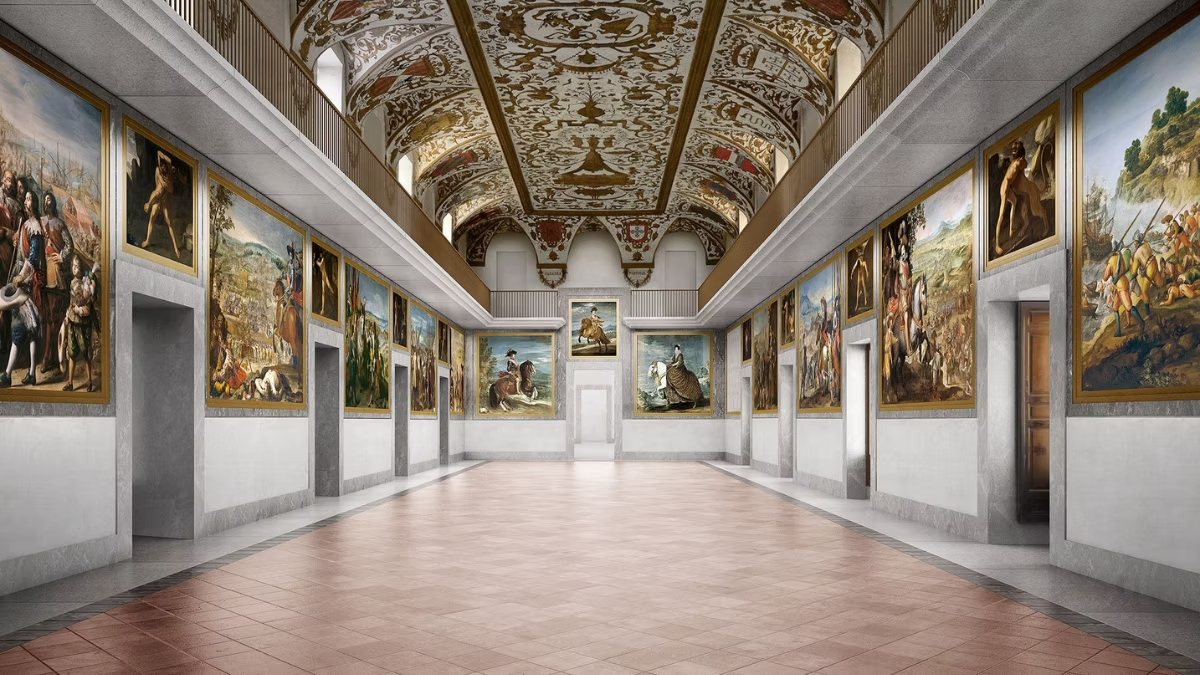
The Prado Museum holds one of the world’s greatest collections of Italian Renaissance and Baroque painting, including the finest collection of Titian outside Venice. Titian’s works are displayed primarily in Rooms 24–27 on the first floor of the Villanueva Building, and include Charles V at Mühlberg, the Venus paintings, Danaë, and Self-Portrait. Raphael’s works are in Room 49. Caravaggio, Ribera, and the Italian Baroque are on the ground floor in Rooms 2–7. Together they constitute one of the Prado’s most important but least-visited collections.
The Prado’s Italian collection is one of the three finest in the world — alongside the Uffizi in Florence and the National Gallery in London — and yet it remains significantly less visited than the Velázquez and Goya galleries that draw most attention. This is partly a function of the museum’s scale: with so much extraordinary Spanish painting to see, visitors often reach the Italian rooms late in their visit or not at all.
This guide covers the essential Italian works at the Prado: what they are, where to find them, and why they deserve the same sustained attention as the more celebrated Spanish masterpieces.
Top Tickets
Why the Prado Has Such an Extraordinary Italian Collection
The Spanish Habsburg monarchs had a direct political, dynastic, and cultural relationship with Italy — ruling the Kingdom of Naples, the Duchy of Milan, and (through the broader Habsburg network) most of the major Italian states for much of the 16th and 17th centuries. This relationship produced direct access to the greatest Italian artists of the Renaissance and Baroque periods.
Charles V was Titian’s primary patron for the last three decades of the painter’s life. Philip II collected Titian obsessively and commissioned major cycles of mythological paintings (the poesie) directly from the artist. The Spanish royal collection that formed the nucleus of the Prado contained dozens of Titian works by the time the museum was founded in 1819.
Similarly, the Spanish viceroys in Naples collected Caravaggio and Ribera (who spent his career in Naples); the Cardinal-Infantes and other Spanish representatives in Rome collected Raphael and Michelangelo-era works; and the Spanish court’s sustained interest in Italian painting across three centuries produced a collection of exceptional depth.
Titian at the Prado
Titian (Tiziano Vecellio, c.1488–1576) is the dominant figure of the Venetian Renaissance and one of the most significant painters in Western history. His career spanned more than 60 years, during which his style evolved from the cool precision of his early manner through the rich, warm colorism of his middle period to the extraordinary loose, broken paint surface of his late work — which directly anticipated Impressionism by 300 years and influenced virtually every subsequent European painter.
The Prado holds approximately 40 Titian works, displayed primarily in Rooms 24–27.
Charles V at Mühlberg (1548) — Room 27
The defining image of European imperial power in the 16th century and the most important equestrian portrait before Velázquez’s series for Philip IV. Charles V, Holy Roman Emperor and King of Spain, rides alone across a twilight landscape after his victory over the Protestant princes at the Battle of Mühlberg in 1547. He is armoured, solitary, triumphant — but the painting’s quality is not simply triumph. There is something approaching melancholy in the solitary figure against the darkening sky, and the twilight landscape suggests the transience of power as much as its possession.
Velázquez studied this painting intensively in the royal collection. The equestrian portraits of the Spanish royal family at the Prado are direct descendants — Velázquez’s response to the template Titian established.
What to look for: The lance held upright — a symbol of triumph without aggression. The armour, identifiable as the actual suit worn by Charles at Mühlberg, now displayed in the Royal Armoury of the Royal Palace of Madrid. The landscape’s sense of fading light.
Philip II Offering the Infante Don Fernando to Heaven (1573–1575) — Room 26
Also known as Gloria or Philip II After the Battle of Lepanto, this large allegorical painting depicts Philip II offering his infant son and heir (the future Philip III) to Heaven following the Christian victory over the Ottoman fleet at Lepanto in 1571. It is one of the most complex and ambitious works Titian produced for the Spanish Crown and one of the clearest examples of how political, religious, and personal themes could be fused in a major commission.
The Poesie: Danaë with Nursemaid and Venus and Adonis — Rooms 25–26
Philip II commissioned a cycle of mythological paintings from Titian in the 1550s that the painter called poesie — poems in paint. Several of the series are at the Prado, including Danaë (which shows Zeus appearing to Danaë as a shower of gold) and Venus and Adonis (which shows Venus restraining Adonis from departing for the hunt that will kill him). These works are among Titian’s most sensuous and technically refined — painted with a freedom and warmth that was understood by 16th-century viewers as an expression of the freedom appropriate to mythological subjects.
Self-Portrait (c.1567) — Room 24
One of the most searching self-portraits in the Western tradition, painted when Titian was in his late seventies. An old man with a white beard looks out at the viewer with an expression of complete self-possession — intelligent, direct, slightly weary. The handling of the paint — particularly the rendering of the white collar against the dark coat — is a masterclass in late Titian technique.
The Bacchanal of the Andrians (1523–1526)
Painted for Alfonso I d’Este, Duke of Ferrara, as part of a cycle of mythological paintings for a private room in the ducal palace in Ferrara (alongside paintings by Bellini and Dosso Dossi). The painting depicts the inhabitants of the island of Andros celebrating a river of wine, their celebration increasingly riotous. A sleeping nude in the right foreground — often read as a self-conscious quotation of classical prototypes — is one of the most discussed figures in Titian’s early work.
Raphael at the Prado
Raphael (Raffaello Sanzio, 1483–1520) is represented at the Prado by several significant works, displayed primarily in Room 49 on the first floor.
The Holy Family of the Oak (c.1518) — Room 49
One of Raphael’s late Roman works, painted in the last years of his life for a Spanish patron in Rome. The composition — the Virgin, the Christ Child, Saint Joseph, and the young John the Baptist in a landscape — is one of Raphael’s most fully resolved: the figures interlock naturally, the landscape recedes convincingly, and the quality of the paint surface achieves a perfection that was the most admired quality of his work in the 16th century.
The Cardinal (c.1510) — Room 49
An extraordinary portrait of an unknown cardinal — one of the finest examples of Raphael’s portraiture and the work that demonstrates most clearly why his portraits were as influential as his religious compositions. The cardinal’s intelligence, caution, and authority are conveyed entirely through the arrangement of his features and the quality of attention in his eyes.
The Holy Family with a Lamb (1507) — Room 49
An early work, painted before Raphael left Florence for Rome, showing the influence of Leonardo (the sfumato landscape, the tender, naturalistic arrangement of the figures) and already demonstrating the compositional clarity and formal balance that would define his mature work.
The Italian Baroque: Caravaggio and Ribera
The ground floor rooms (Rooms 2–7) contain one of the most consistently overlooked sections of the Prado — the Italian Baroque collection, which includes major works by Caravaggio, José de Ribera (who spent his career in Naples), Artemisia Gentileschi, and Guido Reni.
Caravaggio at the Prado
Caravaggio (Michelangelo Merisi da Caravaggio, 1571–1610) is represented by David with the Head of Goliath (c.1600), a work from his Roman period before the flight from Rome that defined the final years of his career. The painting’s chiaroscuro — the extreme contrast between darkness and light that was Caravaggio’s defining technical contribution — is already fully formed, and the treatment of the subject (the young David holding the severed head of the giant he has killed with apparent ambivalence rather than triumph) has the psychological complexity of his mature work.
José de Ribera
Ribera (1591–1652) was born in Valencia but spent his career in Naples, where he combined the influence of Caravaggio with his own intensely physical Spanish devotional sensibility. The Prado holds a significant number of Ribera works, including The Martyrdom of Saint Philip, Jacob’s Dream, and Archimedes — a portrait of the ancient mathematician depicted as a contemporary Spanish worker, laughing.
His paintings reward the visitor who descends to the ground floor rooms and spends time with them. They are technically extraordinary — the handling of light on skin, the rendering of texture and surface, the psychological specificity of the faces — and they are almost always empty of other visitors.
See our hidden gems guide for more on why the Ribera rooms are among the best discoveries in the Prado.
Tintoretto and Veronese
Works by Jacopo Tintoretto and Paolo Veronese — the other major figures of the Venetian Late Renaissance alongside Titian — are distributed through the Italian rooms. Tintoretto’s dramatic compositions and Veronese’s extraordinary use of colour provide essential context for understanding Titian’s own development and the breadth of the Venetian tradition.
Planning Your Visit to the Italian Collection
Primary Italian rooms: Rooms 24–27 (Titian) and Room 49 (Raphael) on the First Floor of the Villanueva Building.
Italian Baroque: Rooms 2–7 on the Ground Floor — less signposted and frequently overlooked.
How long to spend: 30–40 minutes for the Titian rooms; 15 minutes for Raphael; 20–30 minutes for the Baroque rooms if you descend to the ground floor.
Best approach: Include the Titian rooms in a first-floor sweep that moves from Velázquez through Rubens and into the Italian Renaissance — a route that makes the connections between the Spanish, Flemish, and Italian traditions visible and felt. Leave the Baroque rooms for the afternoon session if doing a full-day visit.
For the full-day structure that incorporates the Italian collection at the right point, see our full-day Prado itinerary.
Frequently Asked Questions
Where are the Titian paintings located in the Prado?
Titian’s works are displayed primarily in Rooms 24–27 on the first floor of the Villanueva Building. The most significant works include Charles V at Mühlberg in Room 27, the poesie series in Rooms 25–26, and the Self-Portrait in Room 24.
How many Titian works does the Prado hold?
The Prado holds approximately 40 Titian works, making it the finest Titian collection outside Venice. They span the full arc of his career, from early mythological paintings to the extraordinary loose brushwork of his final decades.
Is the Italian collection included in standard Prado admission?
Yes — the entire Italian collection is included in standard Prado admission. There is no separate ticket or surcharge for the Titian rooms (Rooms 24–27), the Raphael gallery (Room 49), or the Italian Baroque rooms on the ground floor (Rooms 2–7).
How long should I spend in the Italian rooms at the Prado?
Allow 30–40 minutes for the Titian rooms, around 15 minutes for Raphael in Room 49, and 20–30 minutes for the Italian Baroque rooms on the ground floor if you include them. A focused visit to the complete Italian collection takes approximately 60–90 minutes.
Which is the most important Titian painting at the Prado?
Charles V at Mühlberg (1548) in Room 27 is widely considered the most significant. It is the defining image of 16th-century European imperial power and the direct model for the royal equestrian portraiture that Velázquez developed for Philip IV — several of those responses hang elsewhere in the same museum.
