

Las Meninas by Velázquez: A Complete Guide
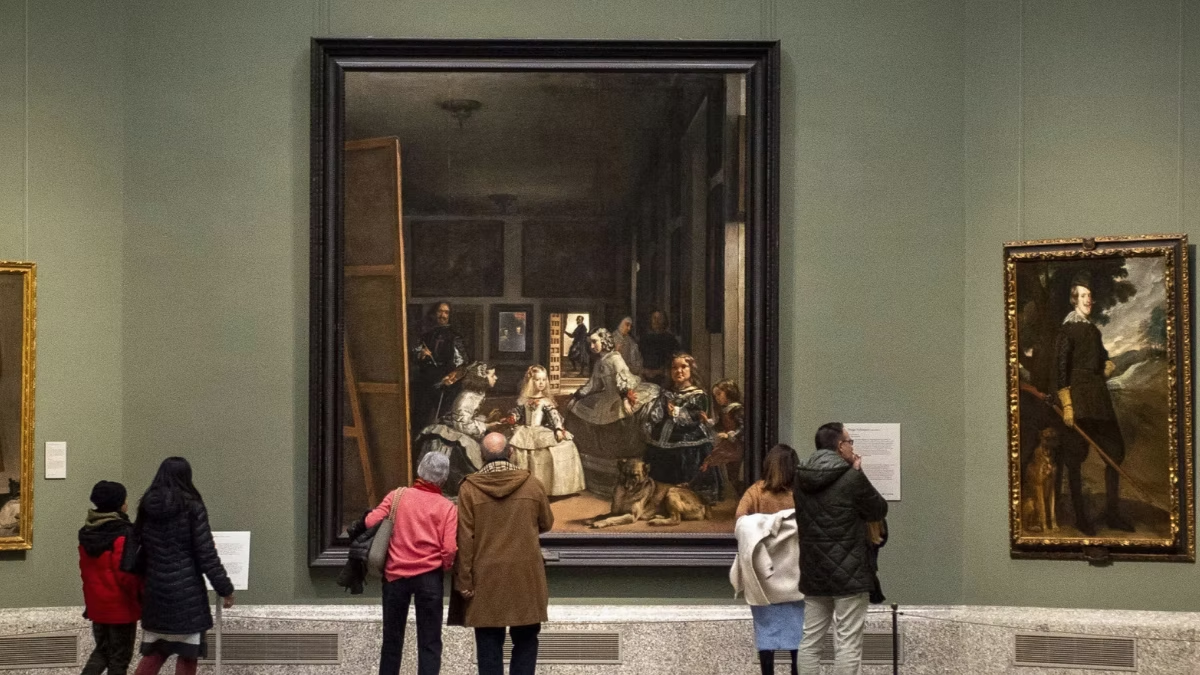
Las Meninas is a large oil painting by Diego Velázquez, completed in 1656 and housed in Room 12 of the Prado Museum in Madrid. It depicts the Infanta Margarita, daughter of King Philip IV of Spain, surrounded by her ladies-in-waiting (the meninas), court attendants, a dog, and two dwarfs. Velázquez painted himself into the scene at the left, standing at a large canvas. A mirror at the back of the room reflects the King and Queen — who appear to be standing where the viewer stands. The painting is widely considered one of the greatest works in the history of Western art.
There is a case — made seriously, by people who have spent their lives studying painting — that Las Meninas is the greatest work ever made. Whether or not you accept that claim, standing in front of it in Room 12 of the Prado is an experience that changes how you think about what painting can do.
This guide tells you everything you need to know before you stand in front of it: who is in the painting, what the famous mirror means, why the painting has been discussed without resolution for nearly 370 years, and what to look for when you are there.
Top Tickets
Basic Facts
| Detail | Information |
|---|---|
| Artist | Diego Rodríguez de Silva y Velázquez |
| Date | 1656 |
| Medium | Oil on canvas |
| Dimensions | 318 × 276 cm (approximately 10.4 × 9 ft) |
| Location | Room 12, Villanueva Building, First Floor, Prado Museum |
| Acquired by the Prado | 1819, at the museum’s founding |
| Previous location | Royal Alcázar of Madrid (royal palace, destroyed by fire 1734) |
Who Is in the Painting?
This is the first question almost every visitor asks, and the answer is more complex than it appears.
The Infanta Margarita — The central figure, a young girl of approximately five years old in a wide, silver-and-rose dress. She is the daughter of King Philip IV of Spain and Queen Mariana of Austria, and the younger sister of the heir apparent. She would later become Holy Roman Empress through marriage to Leopold I.
The Meninas (Ladies-in-Waiting) — The two women on either side of the Infanta are her meninas (from the Portuguese, meaning young noblewomen in royal service). On the left is doña María Agustina Sarmiento, offering the Infanta a small jug of water in a red clay vessel. On the right is doña Isabel de Velasco, curtsying.
The Dwarfs — In the right foreground are two court dwarfs: Maribarbola (on the left, a German dwarf whose actual name was María Bárbola) and Nicolasito Pertusato (on the right, a young Italian dwarf who is nudging the large dog with his foot). Court dwarfs served as companions to royal children and as figures of entertainment. Velázquez painted their portraits with the same unsparing attention he gave to kings — a remarkable statement about the dignity of all subjects.
The Dog — A large mastiff lying in the right foreground, apparently asleep or supremely indifferent to being nudged by Nicolasito. The dog has been identified as one of the royal hunting dogs.
Don José Nieto Velázquez — The figure in the doorway at the back of the room, apparently about to leave or just arriving. He was the Queen’s chamberlain and is shown illuminated by the light of the open door behind him. Note that he shares Velázquez’s surname but was not a close relative.
Diego Velázquez himself — Standing at the far left of the composition, behind a large canvas, holding a palette and brushes. He is dressed in black with the red cross of the Order of Santiago on his chest — a mark of nobility that Velázquez received only after the painting was completed. According to tradition, the cross was added to the painting later, possibly by Philip IV himself or at his instruction.
The King and Queen in the Mirror — At the back of the room, in a rectangular mirror between two paintings, the reflections of King Philip IV and Queen Mariana of Austria are visible. They appear to be standing just outside the picture frame — in the space where the viewer stands.
The Central Mystery: What Is Velázquez Painting?
This is the question that has driven the painting’s discussion for nearly four centuries, and it does not have a definitive answer.
There are three main interpretations:
Interpretation 1: Velázquez is painting the King and Queen
The King and Queen are visible in the mirror because they are standing in the room, in front of the large canvas, being painted. Velázquez has interrupted his work — or is pausing — and the Infanta and her attendants have come to watch. The scene we see is the moment of the sitting, captured from the side.
Interpretation 2: Velázquez is painting the scene we see
The King and Queen are visible in the mirror because their reflection is being cast by the large canvas — i.e., the canvas Velázquez is working on in the painting shows the scene we are looking at, which includes the Infanta and her attendants. The King and Queen are not present in the room but are reflected in the painting-within-the-painting.
Interpretation 3: The viewer is the King and Queen
The mirror reflects the position of the viewer — the person standing where we stand. The King and Queen are where we are. Velázquez is painting us. The painting acknowledges its own viewer in the most direct and destabilising way imaginable.
None of these interpretations is entirely satisfactory. The painting resists resolution by design. What makes it extraordinary is not the puzzle itself but the fact that Velázquez embedded it in a work of such completeness and physical reality that the puzzle does not feel like a trick — it feels like a genuine question about what representation is and what a painting’s relationship to the world it depicts can be.
The Art Historical Significance
Velázquez painted Las Meninas at the height of his powers, eleven years before his death in 1660. By that point he had been court painter to Philip IV for over thirty years — one of the longest and most productive relationships between a royal patron and a major artist in history.
The painting’s significance in art history operates on several levels:
Self-portraiture and the status of the artist
By placing himself in the painting alongside the royal family — and by the later addition of the Order of Santiago cross — Velázquez made an argument about the status of painters. In 17th-century Spain, painting was considered a craft rather than a liberal art, which meant painters were not considered gentlemen. The Order of Santiago was a mark of nobility. Las Meninas is, among other things, an argument for the dignity and intellectual standing of the painter’s vocation.
The representation of representation itself
The painting depicts the act of painting — Velázquez with his canvas — while also being a painting. It shows a mirror reflecting what cannot be painted directly. It places the viewer in the scene. These are not tricks but genuine philosophical propositions about what images are and how they work.
Its influence on subsequent art
The painting has been studied, copied, and responded to by virtually every major European painter since the 17th century. Goya copied it. Manet called it the “theology of painting.” Picasso made 58 variations of it between August and December 1957. Dalí, Francis Bacon, and Richard Hamilton all produced works in direct dialogue with it. No other painting has generated such a sustained response across such a range of artists and periods.
How to See Las Meninas at the Prado
Room 12 is located on the First Floor of the Villanueva Building. Enter via the Puerta de Velázquez, take the main staircase to the first floor, and follow the signage to Room 12. It is the only room in the museum dedicated to a single painting.
Best time to see it: The room is at its quietest in the first 20–30 minutes after opening (10:00 AM) on a weekday. See our best time to visit guide for the full crowd strategy.
How long to spend: A minimum of 15–20 minutes. The painting rewards slow looking — move from the back of the room to the front, from the left side to the right, and take time to read each figure and its relationship to the others.
What to do: Stand at the back of the room first. Then approach slowly. Look at the mirror. Step to the left and then to the right — the spatial depth shifts as your angle changes. Do not try to photograph it (photography is prohibited). Just look.
With a guide: The guided tour and private tour both spend extended time in Room 12. A guide who knows the painting well will point out details and raise the interpretive questions in a way that makes the experience substantially richer.
The VIP pre-opening tour offers the extraordinary experience of encountering Las Meninas in complete quiet, before the museum opens to the public.
Frequently Asked Questions
Where exactly is Las Meninas located in the Prado Museum?
Las Meninas hangs in Room 12 of the Villanueva Building, on the First Floor of the Prado Museum in Madrid. It is the only room in the museum dedicated entirely to a single painting. Enter via the Puerta de Velázquez, take the main staircase to the first floor, and follow the signs for Room 12.
Who painted Las Meninas and when was it completed?
Las Meninas was painted by Diego Rodríguez de Silva y Velázquez and completed in 1656. At the time, Velázquez had been court painter to King Philip IV of Spain for over thirty years. The painting is oil on canvas and measures 318 × 276 cm — roughly 10.4 × 9 feet.
What does the mirror in Las Meninas reflect?
The mirror at the back of the room reflects the figures of King Philip IV and Queen Mariana of Austria. They appear to occupy the same position as the viewer — standing just outside the picture frame. Whether they are actually present in the room being painted, or whether the mirror reflects the canvas Velázquez is working on, remains one of the most debated questions in the history of art.
Can you take photographs of Las Meninas at the Prado?
No — photography is prohibited in Room 12. Visitors are expected to experience the painting directly. This is one of the few rooms in the Prado where the no-photography rule is consistently enforced. Plan to spend your time looking, not photographing.
How long should I spend looking at Las Meninas?
Allow a minimum of 15–20 minutes. The painting rewards sustained, slow looking: start at the back of the room, then approach gradually, moving from side to side to appreciate the spatial depth. With a guide, plan for 30 minutes or more. There is no time limit once you are inside the room.
