

The Garden of Earthly Delights by Bosch: Explained
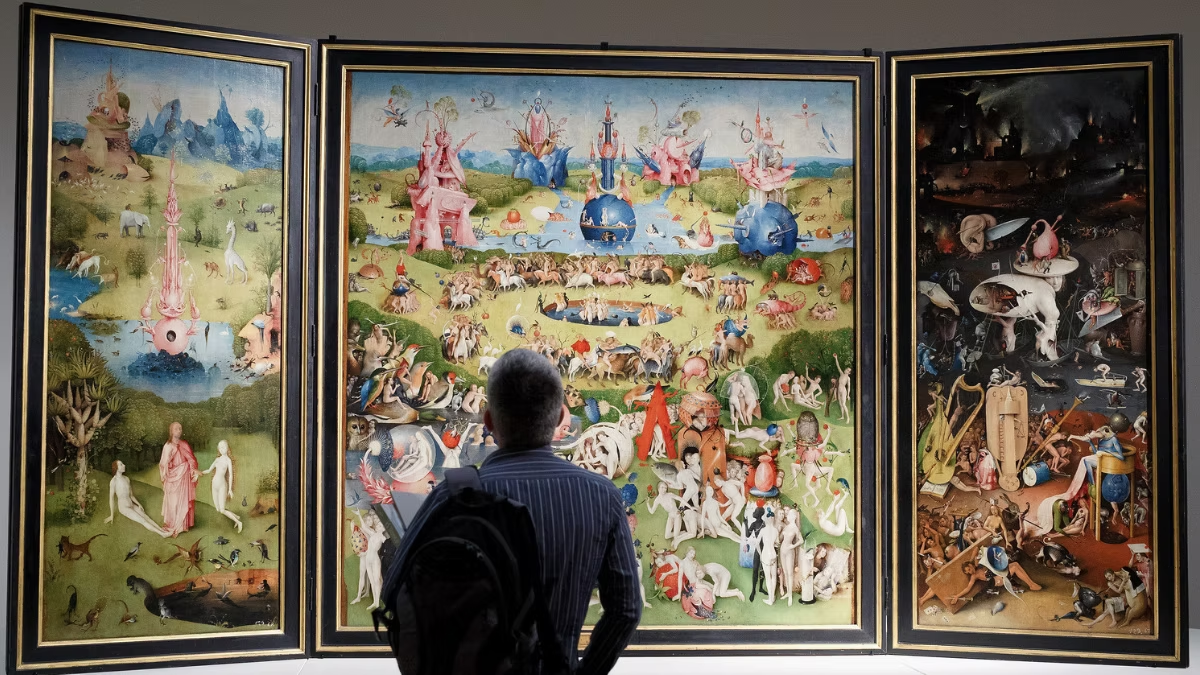
The Garden of Earthly Delights is a large triptych oil painting by the Flemish artist Hieronymus Bosch, painted between approximately 1490 and 1510. It is housed in Room 66 of the Prado Museum in Madrid. The three panels depict, from left to right: the Garden of Eden before the Fall, a fantastical central world filled with human excess and impossible imagery, and a nightmarish hell. It is one of the most complex, debated, and visually extraordinary paintings in the history of Western art.
No painting in the Prado provokes the same immediate, sustained attention as The Garden of Earthly Delights. Most visitors approach it intending to look for a few minutes and find themselves still there fifteen minutes later, searching for the next detail. It is the kind of painting that makes you feel you are looking at something inexhaustibly strange — because you are.
This guide tells you what Bosch was doing, how to read the three panels, what the most debated imagery means, and why a devout Spanish king kept it in his private chambers.
Top Tickets
Basic Facts
| Detail | Information |
|---|---|
| Artist | Hieronymus Bosch (Jheronimus van Aken) |
| Date | c.1490–1510 |
| Medium | Oil on oak panel |
| Dimensions | Centre panel: 220 × 195 cm; each wing: 220 × 97 cm |
| Location | Room 66, Villanueva Building, Ground Floor, Prado Museum |
| Commission | Unknown — possibly for Philip I of Castile or another Netherlandish patron |
| Came to Spain | c.1517, acquired by Henry III of Nassau; later acquired by Philip II |
Who Was Hieronymus Bosch?
Hieronymus Bosch was born in ’s-Hertogenbosch in the southern Netherlands (in present-day Netherlands) around 1450 and died there in 1516. He spent virtually his entire career in his birthplace, working within a prosperous provincial city rather than any major artistic centre. Almost nothing is known about his training, his patrons, or his personal beliefs with any certainty.
What is known is that his works — technically accomplished, fantastically imaginative, populated with creatures and structures unlike anything in the work of his contemporaries — were intensely popular with the Spanish royal family. Philip II of Spain, who was himself a devout Catholic and a major patron of conventional religious art, acquired more than thirty works by Bosch and kept the Garden of Earthly Delights at his private residence at El Escorial. This is one of the central puzzles of the painting’s history.
How to Read the Triptych
A triptych is a work in three panels. When closed, the wings of the Garden of Earthly Delights show a grisaille (monochrome grey) painting of the earth as a transparent sphere on the third day of creation — before plants, animals, or humans. Open, the three panels reveal the full programme.
Left Panel: The Garden of Eden
The left panel shows Paradise — the Garden of Eden before the Fall. God (depicted as Christ) presents Eve to Adam, who has just woken from the sleep in which his rib was taken. The landscape behind them is extraordinary: a pink fountain structure rises from a lake populated by improbable creatures; a giraffe, an elephant, and strange hybrid animals inhabit the margins; a cat walks past carrying a frog in its mouth.
The imagery is simultaneously recognisable as Eden — lush, calm, populated with animals — and subtly, troublingly strange. Some scholars argue that the creatures in the left panel already contain the seeds of what will follow in the central panel. Others read it as straightforwardly paradisiacal. The question — is this an innocent garden, or an already-fallen one? — is unresolved.
Key details to find: The pink fountain in the centre of the lake (sometimes called the Fountain of Life), the unusual hybrid creatures at the lower right, the figures of God, Adam, and Eve at the lower left, and the owl watching from inside the Fountain of Life.
Central Panel: The Garden of Earthly Delights
The largest panel and the most discussed. Hundreds of nude human figures in a vast, impossible landscape — bathing, riding, eating, playing, interacting with giant birds and fruits and glass spheres and architectural forms that have no referent in the natural world. The scale is simultaneously intimate (individual figures doing individual things) and overwhelming (the sheer number and variety of activities).
This panel has been interpreted in radically different ways. For most of the 20th century, the dominant reading was moral: the central panel depicts humanity given over to sensual pleasure — the “garden of earthly delights” of the title — and the right panel shows the consequences. On this reading, the painting is a moral warning.
Alternative readings have argued that the central panel depicts not sinful pleasure but paradise regained — a vision of innocent, pre-lapsarian sexuality free from guilt. The figures do not appear to suffer. They interact with the landscape and with each other with a quality that reads more like play than transgression.
Still other scholars have read the imagery through the lens of Flemish folk culture, alchemy, astrology, and heretical religious movements, producing interpretations that are specific but remain contested.
What the imagery probably is not: A simple illustration of sinfulness. Bosch’s central panel is too complex, too beautiful, and too obviously pleasurable in its own right to function as a straightforward moral deterrent.
Key details to find: The pink globe at the centre upper portion of the panel (into which a couple has climbed); the procession of riders on horseback (and other animals) circling a pool containing women; the giant birds throughout the panel who interact with human figures as equals; the figure emerging from a cracked egg at the lower centre; the glass sphere in the lower left enclosing a couple. And then everything else — the panel repays an hour of unhurried looking.
Right Panel: Hell
The right panel is the most immediately legible: this is clearly a place of punishment, darkness, and horror. Buildings burn in an orange night sky. Human figures are subjected to elaborate tortures that relate, often with mordant specificity, to the pleasures depicted in the central panel — a man is crucified on a harp, musicians are tormented by the instruments they played.
A central figure — sometimes called the Tree Man or the Hell Egg — dominates the lower portion of the panel: a pale, hollow body balanced on two tree-trunk legs standing in boats, its cracked torso open to reveal a tavern, its head topped by a flat disc on which figures dance. It appears to be a self-portrait, or at least a self-reference — Bosch’s most cryptic and discussed insertion of himself into his own work.
The overall impression of the right panel is not simple horror but something more like a nightmare that is simultaneously logical and impossible — a quality Bosch achieves by making each individual element comprehensible while making the combination of all of them overwhelming.
Key details to find: The music scored on a human body in the lower right (researchers have actually played this music, which you can find online); the rabbit carrying a dead man; the Tree Man; the burning buildings reflected in the dark water at the bottom.
Why Did Philip II Keep This Painting in His Private Chambers?
This is the painting’s most persistent historical puzzle. Philip II was one of the most devout Catholic monarchs in European history — a man who launched the Spanish Inquisition against Protestant heresy, built the Escorial monastery as a royal residence and place of prayer, and defined his reign through Catholic orthodoxy. Why did he own more than thirty paintings by Bosch, including the most bizarre and apparently transgressive?
Several explanations have been offered:
Moral reading: Philip read the paintings as moral warnings — visual sermons about the consequences of sin. On this reading, the right panel’s hell was the point, and the central panel’s pleasures were their own argument against themselves.
Mystical reading: Some scholars have argued that Bosch’s imagery was understood in its time through the lens of Flemish mysticism and devotional literature that is now less accessible to us — that what appears transgressive to modern eyes was recognisable to 16th-century viewers as orthodox religious symbolism expressed through non-conventional imagery.
Aesthetic reading: Philip simply found the paintings extraordinary objects and valued them as such, whatever their meaning.
The historical record does not resolve the question. A contemporary of Philip’s, Fray José de Sigüenza, wrote in 1605 that Bosch’s paintings were “a painted satire on the sins and ravings of men” — the moral reading. But the same account notes that Philip kept the paintings privately rather than using them for instruction, which is not how you use a moral warning.
Seeing the Painting at the Prado
Room 66 is on the Ground Floor of the Villanueva Building. The painting is displayed on a dedicated wall and is large enough to be read from across the room — but its detail rewards getting close.
Strategy: First, stand back and take in all three panels together. Understand the left-to-right narrative structure. Then approach the central panel and begin finding individual scenes — work from the foreground upwards, or follow any single thread of imagery across the canvas. Finally, examine the left and right panels at close range.
Best time: The room is significantly less crowded in the early morning (first 90 minutes after opening) and in the late afternoon (after 4:30 PM on weekdays). See our best time to visit guide.
With a guide: The guided tour, masterpieces small group tour, and Prado Made Simple tour all spend extended time with the Bosch triptych. A guide dramatically increases what you see and understand in the available time.
Frequently Asked Questions
Where is The Garden of Earthly Delights located?
The Garden of Earthly Delights is permanently displayed in Room 66 on the Ground Floor of the Villanueva Building at the Prado Museum in Madrid, Spain.
Who painted The Garden of Earthly Delights and when?
The painting was made by Hieronymus Bosch (also known as Jheronimus van Aken), a Flemish artist born around 1450 in ’s-Hertogenbosch in the Netherlands. It was painted between approximately 1490 and 1510.
What do the three panels of The Garden of Earthly Delights depict?
Reading left to right: the left panel shows the Garden of Eden before the Fall; the large central panel depicts a fantastical world of nude human figures, giant birds, impossible architecture, and surreal imagery; the right panel shows a nightmarish hell where figures are subjected to tortures that mirror the pleasures of the central panel.
How long should I spend looking at The Garden of Earthly Delights?
Most visitors find themselves spending at least 15 to 30 minutes with the painting — often longer than they planned. The central panel alone repays an hour of close, unhurried looking. Budget a minimum of 20–30 minutes if the painting is a priority for your visit.
Can you see The Garden of Earthly Delights without a guided tour?
Yes — the painting is accessible with standard Prado Museum entry and no guided tour is required. However, a guide or audio guide significantly increases what you notice and understand, as the painting’s imagery is exceptionally dense and much of its historical and symbolic meaning requires context to appreciate fully.
