

El Greco at the Prado: Key Works & What Makes Him Unique
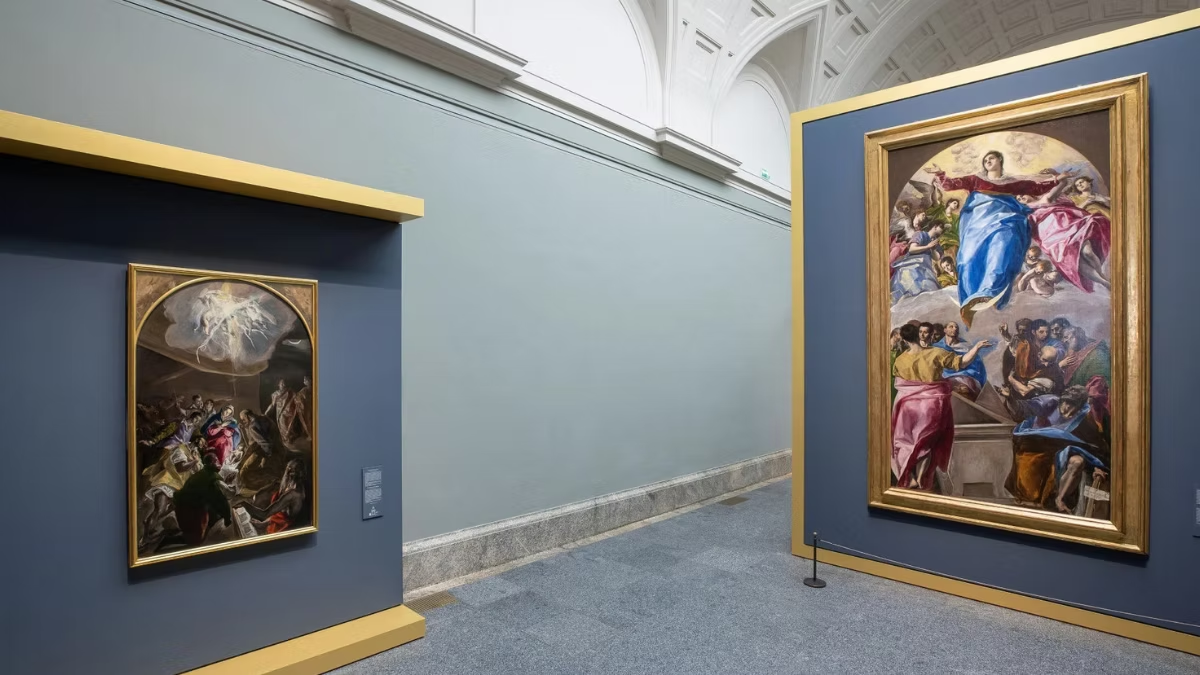
El Greco (Doménikos Theotokópoulos) is represented at the Prado Museum by approximately 38 works, making it one of the finest El Greco collections in the world. His paintings are displayed primarily in Rooms 8B–10B on the ground floor of the Villanueva Building. His most famous works at the Prado include The Nobleman with His Hand on His Chest, The Annunciation, The Holy Trinity, and The Adoration of the Shepherds. El Greco is known for his elongated figures, dramatic colour, and a supernatural sense of light that influenced Cézanne, Picasso, and 20th-century Expressionism.
El Greco is the Prado’s great outlier — a painter born in Crete, trained in Venice under Titian, who ended up in Toledo, Spain, where he spent the last four decades of his life producing work so strange and personal that it was largely dismissed for over two centuries after his death. His rehabilitation in the late 19th and early 20th century came through the Impressionists and then the Expressionists, who recognised in his distorted figures and violent colour something that anticipated their own concerns.
The Prado holds approximately 38 El Greco works — the largest single collection in the world — and visiting his rooms at the museum is one of the most distinctive experiences it offers.
Top Tickets
Who Was El Greco?
Doménikos Theotokópoulos was born in Crete around 1541, when the island was part of the Venetian Republic. He trained initially as a Byzantine icon painter — a tradition that would leave lasting traces in his mature work — before travelling to Venice around 1567, where he entered the workshop of Titian and absorbed the full vocabulary of the Italian Renaissance. Around 1570, he moved to Rome, where he attempted (unsuccessfully) to secure commissions from Pope Pius V.
In 1577, El Greco left for Spain, apparently hoping for commissions from Philip II. He received one commission at El Escorial — The Martyrdom of Saint Maurice — which Philip rejected as unsuitable for its intended altar. El Greco never received another royal commission. He settled in Toledo, where he spent the rest of his life, dying in 1614.
In Toledo, El Greco found his mature style fully: the elongated figures, the electric colour, the sense of figures existing in a supernatural rather than physical space, the twisting poses derived from Michelangelo filtered through his own Byzantine sense of spiritual otherworldliness. He built a successful practice through religious commissions for Toledan churches and convents, and through portraits of the city’s intellectual and religious elite.
His name — El Greco, “The Greek” — was a Spanish nickname. He typically signed his works in Greek characters as Δομηνικος Θεοτοκοπουλος.
The Key Works at the Prado
The Nobleman with His Hand on His Chest (c.1578–1580) — Room 9B
The most celebrated portrait in the Prado outside the Velázquez rooms and the most psychologically intense single work El Greco produced. An unknown Spanish gentleman in black, his right hand placed on his chest — a gesture associated in 16th-century Spain with oaths of loyalty and acts of moral sincerity — his gaze fixed on the viewer with an expression of complete, slightly unnerving presence.
The identity of the sitter has never been established. Candidates have included Diego de Covarrubias (bishop of Segovia and president of the Castilian Council), Juan de Silva (notary to the king), and various Toledan nobles. None has been confirmed.
What to look for: The eyes — El Greco’s ability to convey consciousness through paint is arguably unmatched in 16th-century portraiture. The lace collar, rendered with extraordinary delicacy. And the quality of stillness in the painting — the sense that the man is genuinely present, paused, looking at you.
The Annunciation (1576) — Room 9B
Painted shortly after El Greco arrived in Spain, before his mature style was fully established, The Annunciation shows both his Venetian inheritance (the rich, layered colour, the spatial depth) and the beginning of his personal language (the elongated angel, the sense of supernatural light entering the scene from the left).
The Virgin’s blue robe and the angel’s gold and white create one of the most dramatically coloured compositions in the museum. The painting is more straightforwardly beautiful than the later El Greco works — it is El Greco before he fully became El Greco.
The Holy Trinity (1577–1579) — Room 9B
Painted for the altar of the College of Doña María de Aragón in Madrid, this large work shows God the Father supporting the dead Christ, surrounded by angels. It is one of the first major works El Greco produced in Spain and demonstrates both the scale at which he could operate and his ability to handle multiple figures in a compressed, emotionally charged space.
What to look for: The musculature of Christ’s body — El Greco’s study of Michelangelo is directly visible here — and the quality of the angels’ wings, rendered with a lightness that contrasts with the weight of the central scene.
The Adoration of the Shepherds (1612–1614) — Room 8B
One of El Greco’s last works, painted for his own tomb chapel in Toledo and completed in the year of his death. The elongation of his late style reaches its most extreme point here — the figures are impossibly attenuated, lit by a supernatural light that seems to emanate from the Christ child rather than from any external source.
It is El Greco at his most personal and most radical — a work that makes clear why Cézanne and Picasso responded to him so strongly when his reputation was being reconstructed in the early 20th century.
Knight with His Hand on His Breast — Room 9B
A second portrait of an unknown Spanish gentleman in a similar pose to the more famous Nobleman, but slightly different in date, tone, and execution. Displayed in the same room, the two portraits create a dialogue — variations on the same formal problem, executed with slightly different results.
Additional Works — Rooms 8B–10B
The full El Greco collection at the Prado extends to approximately 38 works across the rooms designated for his display. Major works beyond those listed above include The Resurrection, Pentecost, The Baptism of Christ, and several portraits of Toledo’s intellectual elite. The rooms as a whole give a comprehensive view of his development from the Venetian period through his full Toledo maturity.
What Makes El Greco Unique
El Greco’s distinctiveness operates across several registers:
The elongation of figures. His human forms are stretched beyond anatomical plausibility — sometimes to extraordinary degrees in the late work. This was condemned by his contemporaries as a failure of draftsmanship and celebrated by the Expressionists as an anticipation of their own distortions. It derives partly from the Byzantine icon tradition (in which elongation signified spiritual rather than physical reality) and partly from Mannerist practice, but El Greco takes it further than either tradition.
The supernatural light. El Greco’s paintings are lit from within — or from a source that is clearly not the sun or a candle or any identifiable physical origin. This effect, which his contemporaries found strange and the Impressionists found compelling, creates a sense that the space of his paintings exists in a different register from the physical world.
The colour. Derived from Titian but developed in a direction Titian never took — more acid, more arbitrary, less dependent on the colours of the natural world. A blue robe in a late El Greco is not trying to be the colour of actual cloth; it is something else.
The compressed space. El Greco’s figures inhabit spaces that are simultaneously detailed and impossible — arrangements of bodies and drapery that do not resolve into a coherent three-dimensional room but instead create a kind of visual pressure that is immediately felt even before it is analysed.
El Greco’s Influence
El Greco died in 1614 and was largely forgotten for over two centuries. His rehabilitation began with the Romantic interest in Spain and Spanish art in the early 19th century, accelerated when Manet and Cézanne encountered his work in Madrid, and was complete by the time Picasso — who was born in Málaga and grew up seeing El Greco in the Prado — developed Cubism in part through the formal problems El Greco’s late works posed.
The connection between El Greco’s late work and 20th-century Expressionism is not art historical mythology — it is visible and felt. Standing in front of the late paintings in Rooms 8B and seeing, in them, something that will not be fully understood for another 300 years, is one of the pleasures the Prado provides.
Visiting the El Greco Rooms
Location: Rooms 8B–10B, Ground Floor, Villanueva Building, near the Puerta de Murillo entrance.
Best time: These rooms are consistently less crowded than the Velázquez and Goya galleries on the first floor and in the Jerónimos Building. Mid-morning to early afternoon is perfectly manageable.
How long to spend: 20–30 minutes for a focused visit covering the key works. Longer if you want to read through the full collection.
With a guide: The guided tour and private tour typically include El Greco as a stop. A guide who can explain the Byzantine training, the Venetian influence, and the Toledan context makes the work substantially more legible.
Frequently Asked Questions
Where are the El Greco paintings located in the Prado?
El Greco’s works are displayed in Rooms 8B–10B on the ground floor of the Villanueva Building, near the Puerta de Murillo entrance. These rooms are dedicated almost entirely to his work and hold approximately 38 paintings.
How many El Greco paintings does the Prado have?
The Prado holds approximately 38 works by El Greco — the largest single collection of his paintings in the world. This gives the museum an unmatched breadth of his development, from his early Venetian-influenced works through to the extreme elongation of his late Toledo period.
What is El Greco’s most famous painting at the Prado?
The most celebrated El Greco work at the Prado is The Nobleman with His Hand on His Chest (c.1578–1580), displayed in Room 9B. It is considered one of the most psychologically intense portraits in 16th-century Spanish painting and one of the most iconic works in the entire museum.
How long should I spend in the El Greco rooms at the Prado?
Allow 20–30 minutes for a focused visit covering the key works: The Nobleman with His Hand on His Chest, The Annunciation, The Holy Trinity, and The Adoration of the Shepherds. If you want to explore the full collection and read the room notes in detail, budget 45 minutes to an hour.
Did El Greco influence Picasso and modern art?
Yes — significantly. Picasso grew up in Málaga and encountered El Greco’s work regularly at the Prado from a young age. Art historians connect El Greco’s compressed space, distorted figures, and fractured geometry to the formal problems Picasso explored when developing Cubism. Cézanne and the German Expressionists also drew on El Greco’s supernatural light and emotional distortion.
