

Goya at the Prado: Black Paintings, Saturn & More
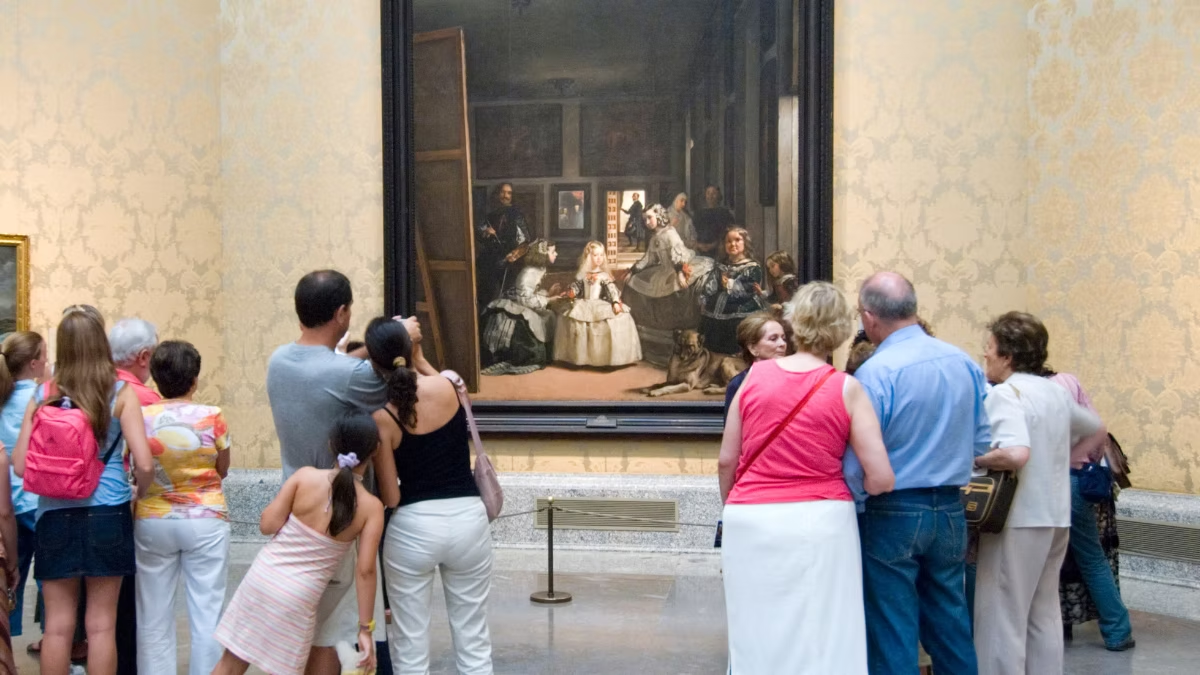
The Prado Museum holds the world’s finest collection of Francisco Goya’s work, including the Black Paintings — 14 works painted directly onto the walls of his house between 1819 and 1823, including Saturn Devouring His Son. The Black Paintings are displayed in Rooms 35–38 of the Jerónimos Building. The museum also holds the Naked Maja, the Clothed Maja, major court portraits, tapestry cartoons, and the Third of May 1808 — together constituting the complete arc of Goya’s career from early optimism to late visionary darkness.
Francisco de Goya is not simply the most important Spanish artist of the late 18th and early 19th century. He is one of the most important artists in the entire Western tradition — a painter whose career spanned more than fifty years, encompassed extraordinary stylistic range, and ended with a body of work so psychologically intense and formally radical that it was not fully understood for another century after his death.
The Prado holds more Goya than any other institution in the world. Visiting it with attention to Goya’s full presence — not just the Black Paintings, but the tapestry cartoons, the court portraits, the Majas, and the war paintings — is one of the richest single-artist experiences available in any museum.
Top Tickets
Goya at the Prado: Overview
The Prado’s Goya collection is divided between several areas of the museum, corresponding roughly to the phases of his career:
| Works | Location | Period |
|---|---|---|
| Tapestry cartoons, early portraits | Rooms 30–34 | 1770s–1790s |
| The Naked and Clothed Maja | Room 36 | c.1797–1808 |
| Court portraits of Charles IV and family | Rooms 32–33 | 1790s–1800s |
| The Third of May 1808 and war paintings | Room 64 | 1814 |
| The Black Paintings | Rooms 35–38 | 1819–1823 |
A full visit to the Goya collection at the Prado takes approximately 60–90 minutes and covers a span of artistic development that has almost no parallel in the history of art.
The Early Goya: Tapestry Cartoons and Court Painting (Rooms 30–34)
Goya’s early career was defined by his work as a tapestry designer for the Royal Manufactory of Santa Bárbara, which provided wall coverings for the royal palaces. The cartoons — large oil paintings used as templates for the weavers — are bright, optimistic, full of popular Madrid life: picnickers, kite-fliers, blind guitarists, children playing. They show a young artist with every reason for confidence and no visible premonition of what was to come.
From this period the Prado also holds major court portraits of the Spanish royal family and aristocracy. The portrait of the Duchess of Alba and Goya’s self-portraits from the 1790s show his technical mastery at its most assured.
Key works: The Swing, The Parasol, The Blind Man’s Buff — all full of colour, movement, and popular energy that makes the later Black Paintings feel like they were painted by a completely different person. They were not.
The Majas: A Scandal Across Two Paintings (Room 36)
Two paintings, same subject, same room. The Naked Maja (La maja desnuda) and the Clothed Maja (La maja vestida) depict the same reclining woman in exactly the same position — one dressed in a tight-fitting jacket and trousers, one completely nude. The identity of the subject has never been definitively established; candidates have included the Duchess of Alba and Pepita Tudó, the mistress of Manuel de Godoy (the prime minister who commissioned the paintings).
The Naked Maja caused a scandal that led to Goya being summoned before the Spanish Inquisition in 1815. The charges were eventually dropped, but the paintings remained controversial — not simply because of the nudity but because of the directness of the woman’s gaze. Unlike the idealised nudes of the mythological tradition (in which a Venus or a Danae looks away or is caught unawares), the Naked Maja looks directly at the viewer with an expression of complete equanimity. She is not a goddess. She is a contemporary woman, and she knows she is being looked at.
What to look for: The faces — many scholars believe the heads were painted separately from the bodies. The Naked Maja’s gaze. The formal relationship between the two paintings displayed together.
The Third of May 1808 — Room 64
Goya’s response to the Napoleonic occupation of Spain and the brutal suppression of the Madrid uprising of May 1808. The Second of May (also in the Prado) shows the chaos of the uprising; the Third of May shows the executions that followed.
A man in a white shirt throws his arms wide — simultaneously a gesture of surrender and a cruciform reference — as French soldiers execute him by lamplight. The faces of the soldiers are hidden; the faces of the victims are not. It is one of the most powerful anti-war paintings ever made and directly influenced Édouard Manet’s The Execution of Emperor Maximilian and Picasso’s Guernica.
What to look for: The white shirt, luminous against the dark ground. The lantern as the only light source. The anonymous faces of the soldiers (dehumanised by their role) against the individualised faces of the victims (humanised by their fear).
The Black Paintings (Rooms 35–38): The Fullest Goya
The Black Paintings are the culmination of the Prado’s Goya collection and among the most extraordinary works in any museum in the world.
Between 1819 and 1823, Goya — in his seventies, profoundly deaf since 1793, politically marginalised after the return of Ferdinand VII’s absolutist rule, living in increasing isolation in a farmhouse outside Madrid called the Quinta del Sordo (House of the Deaf Man) — painted 14 large works directly onto the plaster walls of the two main rooms of his house. He apparently did this for himself, without any intention of exhibiting or selling the works. They were never meant to be seen.
After Goya’s death in Bordeaux in 1828, the house and its paintings passed through several owners. In the 1870s, the paintings were transferred from the walls onto canvas by the Belgian artist Salvador Martinez Cubells. They came to the Prado in 1881 as a donation from the German banker Baron Émile d’Erlanger.
Saturn Devouring His Son — The most famous of the series. The god of time devours one of his children — who in classical myth was prophesied to overthrow him. Goya’s version has no classical elegance or mythological distance: it is pure terror, painted with a speed and ferocity that makes it feel violent at the level of the paint itself. The scale — Saturn is enormous, occupying most of the canvas — is part of its power. This painting was on the lower floor of the house, visible from the entrance.
Witches’ Sabbath (The Great He-Goat) — A large crowd of figures surrounding a monstrous goat-headed figure preaching to them. Some figures are ecstatic; others are blank or terrified. The goat — the Devil — addresses his congregation with something between a sermon and a mockery of one.
The Dog — The most affecting of the series for many visitors. A small dog’s head, seen from slightly above, emerging from what appears to be a vast, featureless expanse of murky colour. Nothing else. The dog looks up at something outside the frame. The painting has been interpreted as a metaphor for human isolation, for the experience of aging, for the relationship between the individual and an indifferent universe. It resists all single interpretations. It simply is.
Two Old Men Eating — Two emaciated old figures, one apparently a hallucination or a death’s head, eating or consuming something. Painted with the loose, rapid mark-making of the late Goya.
Judith and Holofernes, The Fates, Duel with Cudgels, Fight to the Death — The remaining Black Paintings each carry their own distinct psychological weight. Together, displayed in the rooms as they were (roughly) on the walls of the house, they form a complete world — Goya’s private statement about human nature, violence, irrationality, and the proximity of terror to ordinary life.
What to look for in all the Black Paintings: The mark-making — visible, rapid, almost expressionistic brushwork that is unlike anything else in 19th-century painting. The scale — these are large works, designed for walls, and the museum’s rooms approximate (though cannot fully replicate) their original context. And the formal relationship between works: the Black Paintings make most sense as a sequence, not as individual objects.
How to See the Full Goya Collection
Allow 60–90 minutes for the complete Goya rooms. Begin with the tapestry cartoons in Rooms 30–34 (which set the biographical context), move through the Majas and court portraits, pause at the Third of May, and end with the Black Paintings. Moving in this order, you follow the arc of a life — from optimism to catastrophe — and the Black Paintings land with full force.
For guided interpretation of Goya’s full collection with expert commentary, the private tour or 3-hour private tour allows the depth of engagement the collection deserves. The masterpieces small group tour covers the Black Paintings in the context of the broader highlights.
Frequently Asked Questions
What are the Black Paintings at the Prado?
The Black Paintings are 14 large works that Goya painted directly onto the plaster walls of his farmhouse near Madrid between 1819 and 1823. Created in his seventies and never intended for public display, they include Saturn Devouring His Son and The Dog. They were transferred to canvas in the 1870s and donated to the Prado in 1881, where they are displayed in Rooms 35–38.
Where are Goya’s Black Paintings displayed in the Prado?
The Black Paintings are displayed in Rooms 35–38 of the Prado’s Jerónimos Building. The rest of the Goya collection is spread across the same building: tapestry cartoons and early portraits in Rooms 30–34, the Majas and court portraits in Rooms 32–33 and 36, and the Third of May 1808 in Room 64.
What is Saturn Devouring His Son?
Saturn Devouring His Son is the most famous of Goya’s Black Paintings. It depicts the god Saturn consuming one of his own children, a figure from classical mythology prophesied to overthrow him. Goya’s version strips away any mythological elegance — it is pure terror painted with extraordinary speed and ferocity, and was originally on the lower floor of Goya’s house, visible from the entrance.
How long does it take to see Goya’s collection at the Prado?
Allow 60–90 minutes for the complete Goya rooms. This covers the tapestry cartoons, the Majas, the court portraits, the Third of May 1808, and the Black Paintings. Visiting in chronological order — from the early career through to the Black Paintings — is recommended for the fullest impact.
What other Goya works can I see at the Prado besides the Black Paintings?
The Prado’s Goya collection extends far beyond the Black Paintings. It includes the Naked Maja and Clothed Maja (Room 36), the Third of May 1808 (Room 64), major court portraits of Charles IV and the Spanish royal family (Rooms 32–33), and the tapestry cartoons from the 1770s to the 1790s (Rooms 30–34) — together tracing the full arc of one of the most remarkable careers in the history of Western art.
