

Must-See Masterpieces at the Prado Museum
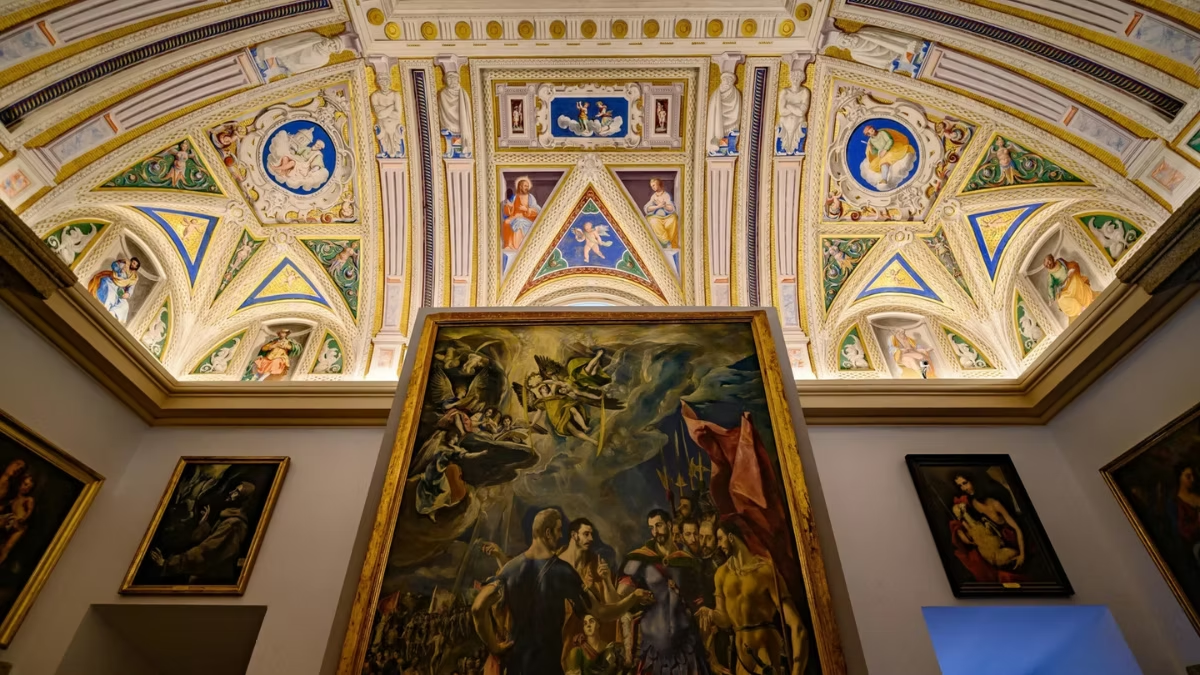
The must-see masterpieces at the Prado Museum include Las Meninas by Velázquez (Room 12), The Garden of Earthly Delights by Hieronymus Bosch (Room 66), Goya’s Black Paintings including Saturn Devouring His Son (Rooms 35–38), Charles V at Mühlberg by Titian (Room 27), The Three Graces by Rubens (Room 29), and The Annunciation by El Greco (Room 9B). These works represent the absolute pinnacle of the Prado’s collection and should anchor any visit, however short.
The Prado Museum holds approximately 3,000 works on display at any one time. Of these, a handful are not simply excellent paintings but objects that changed the course of art history — works that artists, critics, and curators across five centuries have returned to as reference points for what painting can achieve.
This guide covers those works: what they are, where to find them, what makes them significant, and what to look for when you are standing in front of them. It is built around the premise that seeing ten works properly is more valuable than walking past a hundred.
Top Tickets
Las Meninas — Diego Velázquez (1656)
Location: Room 12, Villanueva Building, First Floor
There is a case for Las Meninas being the greatest painting ever made. It is certainly the most analysed. Velázquez depicts the young Infanta Margarita surrounded by her ladies-in-waiting, two dwarfs, a large dog, and — most extraordinarily — himself, standing at a large canvas in the left of the frame. In the mirror at the back of the room, the reflection of the King and Queen of Spain.
The painting’s central mystery is its viewpoint: if the King and Queen are reflected in the mirror, they must be standing where we stand — meaning Velázquez is painting them, and we are where they were. But Velázquez has also painted himself painting. Is this a painting of the royal couple? Of the Infanta? Of the act of painting itself?
No one has resolved it definitively. That is partly why it has been discussed without interruption for nearly 370 years.
What to look for: The mirror at the back centre of the room, the self-portrait on the left, the light source from the right (a doorway), and the extraordinary spatial recession that makes the room feel genuinely three-dimensional.
Best time to see it: First 20 minutes after the museum opens on a weekday morning. The room fills quickly. See our best time to visit guide for the full strategy.
The Garden of Earthly Delights — Hieronymus Bosch (c.1490–1510)
Location: Room 66, Villanueva Building, Ground Floor
The most discussed triptych in the history of painting. Bosch’s three panels move from Eden (left) through an impossible central world of human excess (centre) to a nightmarish hell (right). The central panel alone contains hundreds of tiny figures engaged in activities that range from the simply strange to the explicitly transgressive — each one apparently meaningful, most still debated by scholars.
The painting came to Spain through Philip II, who reportedly kept it in his private chambers at El Escorial — which raises its own questions about why a devout king was so attached to what appears to be a vision of human sinfulness. Some scholars argue the painting is a moral warning; others that it is a celebration; others that it operates through alchemical symbolism entirely different from straightforward theological reading.
What to look for: The pink globe in the left panel, the musical torture instruments in the right panel (a harp, a lute), the human figure in the central bottom foreground emerging from an eggshell, and the general principle that every square centimetre of the central panel contains something worth finding.
How to read it: Left panel first (Eden, creation), central panel (the world given over to pleasure), right panel (the consequences). The garden of the title is the central panel — a paradise that has gone wrong.
Saturn Devouring His Son — Francisco de Goya (1820–1823)
Location: Rooms 35–38 (the Black Paintings), Jerónimos Building, Ground Floor
Painted directly onto the walls of Goya’s own house — a farmhouse outside Madrid called the Quinta del Sordo — by a man in his seventies, profoundly deaf, politically marginalised, and living through the collapse of the Enlightenment values he had believed in. The Black Paintings were transferred to canvas after Goya’s death and came to the Prado in 1881.
Saturn is the most famous of the series. The god of time devouring one of his children — who, in myth, was prophesied to overthrow him — rendered at a scale and with a ferocity that has no precedent in art history. The image is visceral, irrational, and painted at extraordinary speed directly onto a wall. It is not a public work. It was never intended to be seen by anyone except Goya.
What to look for: The knuckles. The size of Saturn’s hands relative to the body. The way the paint has been applied — rapidly, almost violently. And then the other Black Paintings in the surrounding rooms, which must be read as a complete series.
The full Black Paintings series includes: Saturn, Witches’ Sabbath, The Dog, Judith and Holofernes, Two Old Men Eating, and seven others. All are displayed together. Allow 20 minutes minimum.
Charles V at Mühlberg — Titian (1548)
Location: Room 27, Villanueva Building, First Floor
The defining image of European imperial power in the 16th century. Titian’s equestrian portrait of Holy Roman Emperor Charles V — armoured, alone, on a dark horse at dusk after his victory at the Battle of Mühlberg in 1547 — established the template for royal equestrian portraiture that would last two hundred years.
Velázquez’s equestrian portraits of the Spanish monarchs (displayed in nearby rooms) are direct descendants of this painting. The armour worn by Charles in this portrait is displayed in the Royal Armoury at the Royal Palace of Madrid — visible if you visit on the Royal Palace and Prado combo tour.
What to look for: The lance held upright (a symbol of triumph without aggression), the twilight landscape in the background, and the complete isolation of the figure — Charles faces no enemy and acknowledges no viewer.
The Three Graces — Peter Paul Rubens (c.1630–1635)
Location: Room 29, Villanueva Building, First Floor
Rubens at his most joyous and technically supreme. Three female figures — the Three Graces of classical mythology — dance in a circle, seen from three different angles simultaneously, their arms interlaced. The painting is an exercise in showing the human body in motion from multiple viewpoints within a single composition, and a demonstration of Rubens’s ability to render skin with an almost tactile quality.
The figures are unidealised by the standards of classical painting — full-bodied, warm, alive. One is widely believed to be a portrait of Rubens’s second wife, Hélène Fourment. The painting was in Rubens’s personal collection at his death and was purchased by Philip IV of Spain.
What to look for: The diaphanous scarf (technically extraordinary — fabric made almost to float in paint), the spatial relationship between the three figures, and the landscape background that gives the painting its sense of outdoor light.
The Nobleman with His Hand on His Chest — El Greco (c.1578–1580)
Location: Room 9B, Villanueva Building, Ground Floor
El Greco’s most iconic portrait and one of the most penetrating images of individual dignity in the history of painting. An unknown Spanish gentleman, dressed in black, his right hand placed on his chest in a gesture of loyalty or sincerity — painted with El Greco’s characteristic elongation and an intensity of psychological presence that makes the subject feel genuinely, uncomfortably alive.
The identity of the sitter has never been established. The gesture — hand on chest — was associated in 16th-century Spain with oaths of loyalty, with receiving the Eucharist, and with acts of moral affirmation. The painting offers no resolution.
What to look for: The eyes — El Greco’s ability to convey consciousness through paint is extraordinary — and the lace collar, rendered with a delicacy that contrasts sharply with the intensity of the face above it.
The Annunciation — El Greco (1576)
Location: Room 9B, Villanueva Building, Ground Floor
Painted in the years immediately after El Greco arrived in Spain from Venice and Toledo, this work demonstrates both his Venetian training (the rich colour, the spatial depth) and his emerging personal style (the elongated figures, the supernatural light). The Virgin’s blue robe and the angel’s gold-and-white robes create one of the most dramatically coloured compositions in the museum.
The Surrender of Breda — Diego Velázquez (1634–1635)
Location: Room 14, Villanueva Building, First Floor
One of the great history paintings of the 17th century. Velázquez depicts the moment when the Dutch commander Justin of Nassau surrendered the city of Breda to the Spanish general Ambrogio Spinola in 1625. But rather than a scene of triumph and humiliation, Velázquez shows Spinola leaning forward to prevent Nassau from kneeling — a gesture of magnanimity and mutual respect between soldiers.
What to look for: The forest of lances on the Spanish side (which gives the painting its alternative title, Las Lanzas) against the comparative disorder of the Dutch side, and the way Velázquez places the viewer within the scene rather than observing it from outside.
The Naked Maja and The Clothed Maja — Francisco de Goya (c.1797–1800 and c.1800–1808)
Location: Room 36, Jerónimos Building, Ground Floor
Two paintings of the same reclining figure — one clothed, one naked — displayed together. The identity of the subject has never been definitively established. The paintings caused a scandal that led to Goya being summoned before the Spanish Inquisition. They are among the first depictions of a nude female figure in Western art that is clearly an actual contemporary person rather than a mythological figure.
What to look for: The differences between the two faces — many scholars believe the heads were painted separately from the bodies — and the challenging directness of the Naked Maja’s gaze, which is unlike anything in the Prado’s collection of idealised nudes.
Planning Your Visit Around the Masterpieces
These works are spread across different floors and buildings. For an efficient route through the essential works, see our 2-hour highlights itinerary. For visitors who want guided interpretation of each work, the masterpieces small group tour is designed specifically around this selection.
For each major work explored in full detail, see the dedicated articles in our What To See category:
- Las Meninas by Velázquez: A Complete Guide
- Goya at the Prado: Black Paintings, Saturn & More
- The Garden of Earthly Delights by Bosch: Explained
- El Greco at the Prado: Key Works & What Makes Him Unique
- Velázquez at the Prado: Beyond Las Meninas
- Rubens & the Flemish Masters at the Prado
Frequently Asked Questions
What is the most famous painting in the Prado Museum?
Las Meninas by Diego Velázquez (1656), displayed in Room 12, is widely considered the Prado’s most iconic work and one of the most significant paintings in Western art history. Goya’s Saturn Devouring His Son and Bosch’s The Garden of Earthly Delights are also among the most visited works in the collection.
Where is Las Meninas located in the Prado Museum?
Las Meninas is displayed in Room 12 of the Villanueva Building on the First Floor. The room fills quickly after opening — arriving in the first 20 minutes of the day is the most reliable way to see it without crowds.
How long do I need to see the Prado’s must-see masterpieces?
To see the key masterpieces properly — Las Meninas, The Garden of Earthly Delights, the Black Paintings, Charles V at Mühlberg, The Three Graces, and the El Greco rooms — allow a minimum of two hours. A focused route is achievable if you plan in advance and arrive at opening time.
Are Goya’s Black Paintings in the Prado Museum?
Yes — all 14 of Goya’s Black Paintings, including Saturn Devouring His Son, are displayed together in Rooms 35–38 of the Jerónimos Building on the Ground Floor. They were originally painted directly onto the walls of Goya’s house outside Madrid and were transferred to canvas after his death.
Is The Garden of Earthly Delights by Bosch permanently on display at the Prado?
Yes. Hieronymus Bosch’s The Garden of Earthly Delights triptych is permanently displayed in Room 66 of the Villanueva Building on the Ground Floor. It has been in Spain’s royal collections since the 16th century, acquired by Philip II, who reportedly kept it in his private chambers at El Escorial.
