

How to See the Prado in 2 Hours: Essential Highlights Route
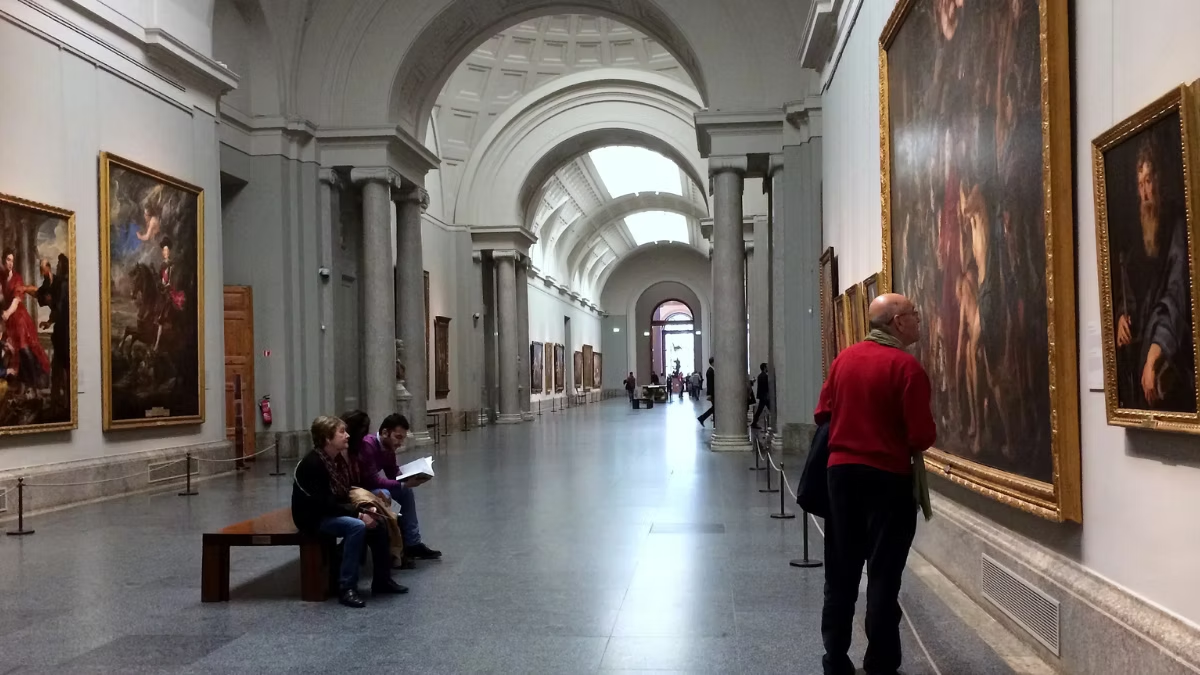
Visiting the Prado Museum in 2 hours is entirely achievable if you follow a focused route. Enter via the Puerta de Velázquez, head immediately to Room 12 for Las Meninas, continue to the Velázquez portraits in Rooms 14–16, move to Room 66 for Bosch’s Garden of Earthly Delights, and finish with Goya’s Black Paintings in Rooms 35–38. This route covers the absolute essential works in approximately 90–120 minutes and leaves time for the Goya early works in Rooms 30–34.
Two hours at the Prado is not a comfortable, leisurely visit — but it is enough time to see the paintings that make this one of the world’s five great art museums, if you arrive with a plan and do not deviate from it. The key is absolute prioritisation: go to the most important works first, while your energy and concentration are highest, and treat everything else as optional.
This guide gives you the exact room-by-room route to follow.
Top Tickets
Before You Enter: Essential Preparation
Book your ticket online. Even for a short visit, booking a timed-entry ticket in advance is important — during peak season, walk-up availability at your preferred time is not guaranteed. The Prado Museum entry ticket can be booked with free cancellation and provides a QR code for direct entry.
Arrive at your scheduled time — not late. With only 2 hours, losing 15 minutes at the entrance because you were late to your slot creates real pressure.
Have the QR code ready before reaching the door. Open the confirmation email on your phone before joining the entrance queue.
Wear comfortable shoes. This route covers significant ground across two buildings and three floors.
Skip the cloakroom queue by travelling light. A small day bag is permitted in the galleries. Large backpacks must go to the cloakroom. Minimise what you carry.
The 2-Hour Highlights Route
Stop 1 — Las Meninas (Velázquez, 1656) — Room 12 | Allow 15–20 minutes
How to get there: Enter via Puerta de Velázquez. Go through security. Collect a map. Turn right and follow the central corridor on the main floor (Floor 1) to Room 12. It is well signposted.
Las Meninas is the centrepiece of the Prado and of Western painting. Give it time. Stand at the back of Room 12 first to take in the full composition — the Infanta Margarita, the ladies-in-waiting, the mirror, Velázquez himself — and then move closer to examine the brushwork. Velázquez’s technique up close is as remarkable as the painting’s concept at a distance.
Do not leave without looking at the mirror at the back of the room. It reflects the King and Queen of Spain — meaning they are standing where you stand.
Stop 2 — Velázquez: The Surrender of Breda and Royal Portraits — Rooms 14–16 | Allow 10 minutes
How to get there: From Room 12, continue along the central hall to Rooms 14–16.
The Surrender of Breda (Room 14) is the great history painting of the Spanish Golden Age — 300 soldiers’ lances and a moment of human generosity between enemies. The equestrian portraits of the Spanish monarchs in Rooms 15–16 show the scale at which Velázquez worked and the influence of Titian’s Charles V at Mühlberg (Room 27, if you have extra time later).
Stop 3 — Titian: Charles V at Mühlberg — Room 27 | Allow 5–8 minutes
How to get there: From Room 16, continue along the central corridor past Rooms 17–26 to Room 27.
The painting that established the language of European royal portraiture. Charles V in armour at twilight, alone, triumphant. The lance, the horse, the landscape — all of it was imitated for 200 years. Brief here — this is context for Velázquez as much as a standalone stop.
Stop 4 — Rubens: The Three Graces and Flemish Baroque — Rooms 28–29 | Allow 8 minutes
How to get there: Room 28 is adjacent to Room 27.
The Three Graces is among the most technically accomplished works in the museum — Rubens’s rendering of skin and the diaphanous scarf is extraordinary. The surrounding rooms contain other major Rubens works and the core of the Flemish Baroque collection. Move through at pace unless something specific captures you.
Stop 5 — The Garden of Earthly Delights (Bosch, c.1490–1510) — Room 66 | Allow 15–20 minutes
How to get there: From Room 29, descend to the ground floor (Floor 0) via the stairs or lift. Follow signage to Room 66, which is in the central section of the building. This is one of the longer transitions on the route — allow 3–4 minutes of walking.
Room 66 is where Bosch’s triptych is displayed. The painting rewards slow, detail-oriented looking. Start with the left panel (Eden), move to the extraordinary central panel (the garden itself, full of impossible scenes), and finish with the nightmarish right panel (hell). Give yourself 15 minutes minimum. The detail is inexhaustible.
Stop 6 — El Greco — Rooms 8B–10B | Allow 8 minutes
How to get there: From Room 66, move to the western section of the ground floor. Rooms 8B–10B are in the area near the Puerta de Murillo entrance.
El Greco’s elongated figures and burning colour are unlike anything else in the Prado. The Nobleman with His Hand on His Chest is the must-see work — one of the most psychologically intense portraits in the collection. Spend a moment with it and continue.
Stop 7 — Goya’s Black Paintings — Rooms 35–38 | Allow 20 minutes
How to get there: From the El Greco rooms, cross through the central ground floor to the Jerónimos Building. Follow signage to Rooms 35–38.
This is the most powerful sequence of rooms in the Prado — possibly in any museum. Goya’s Black Paintings, transferred from the walls of his house, are displayed together. Saturn Devouring His Son is the most famous. The Dog, a haunting image of a small animal partially submerged in darkness, is the most affecting. Witches’ Sabbath is the most visually dramatic.
Allow 20 minutes and do not rush. These rooms require a different quality of attention from the earlier stops.
Optional Stop 8 — Goya’s Early Works and Tapestry Cartoons — Rooms 30–34 | Allow 10 minutes (if time permits)
How to get there: These rooms are adjacent to the Black Paintings area in the Jerónimos Building.
The earlier Goya — the tapestry cartoons, the portraits, the Majas — provide essential contrast to the Black Paintings. If you have time remaining after Stop 7, a brief walk through these rooms shows the full arc of Goya’s career: from the bright, optimistic court painter to the isolated, visionary old man of the Black Paintings.
Full 2-Hour Route Summary
| Stop | Work / Room | Time |
|---|---|---|
| 1 | Las Meninas — Room 12 | 15–20 min |
| 2 | Surrender of Breda, royal portraits — Rooms 14–16 | 10 min |
| 3 | Charles V at Mühlberg — Room 27 | 5–8 min |
| 4 | The Three Graces, Flemish works — Rooms 28–29 | 8 min |
| 5 | Garden of Earthly Delights — Room 66 | 15–20 min |
| 6 | El Greco — Rooms 8B–10B | 8 min |
| 7 | Goya’s Black Paintings — Rooms 35–38 | 20 min |
| 8 | Goya early works (optional) — Rooms 30–34 | 10 min |
| Total | ~110–120 min |
Tips for the 2-Hour Visit
- Do not stop at works not on your list, even if they are beautiful — you will run out of time
- Move between stops with purpose — the museum map shows the most direct routes
- If you find a particular room too crowded to engage with (most likely Room 12), note the time and return later in the visit — crowds shift during a 2-hour window
- The museum café is not on this route — plan food before or after, not during
- For your next visit (and there should be one), explore the Italian Baroque, the Raphael rooms, the Dürer, and the full Titian collection that this route barely touches
Going Beyond the 2-Hour Visit
If you have more time available, our full-day Prado itinerary extends this route into the complete collection. For guided interpretation of the highlights, the masterpieces small group tour covers the same works in approximately 2 hours with expert commentary.
Frequently Asked Questions
Can you really see the Prado Museum in 2 hours?
Yes — if you follow a focused route. Two hours is enough time to see the essential highlights: Las Meninas, Goya’s Black Paintings, Bosch’s Garden of Earthly Delights, and the key Velázquez and Titian works. The route in this guide covers approximately 110–120 minutes at a purposeful pace.
Which entrance should I use for the 2-hour highlights route?
Use the Puerta de Velázquez on the east side of the building. It places you directly on the main floor closest to Room 12 and Las Meninas, the first stop on the route. Entering from the Puerta de Goya or Puerta de Murillo adds unnecessary walking time at the start of the visit.
Do I need to book Prado Museum tickets in advance?
Yes — particularly during peak season (spring and summer). Walk-up tickets are sometimes available, but timed-entry slots at popular hours can sell out. Booking online guarantees your preferred entry time and lets you bypass the ticket queue entirely, which is important when you only have 2 hours.
Is the Prado Museum free at any time?
Yes — the Prado offers free admission Monday to Saturday from 18:00 to 20:00, and on Sundays and public holidays from 17:00 to 19:00. These free windows are popular and the museum can be busy during them; timed-entry booking is still recommended to secure your slot.
How far apart are Las Meninas and Goya’s Black Paintings?
Las Meninas is in Room 12 on Floor 1 of the main building. Goya’s Black Paintings are in Rooms 35–38 in the Jerónimos Building. This route takes you through several intermediate stops across both floors before arriving at the Black Paintings; allow 3–5 minutes of walking between each major stop.
