

Velázquez at the Prado: Beyond Las Meninas
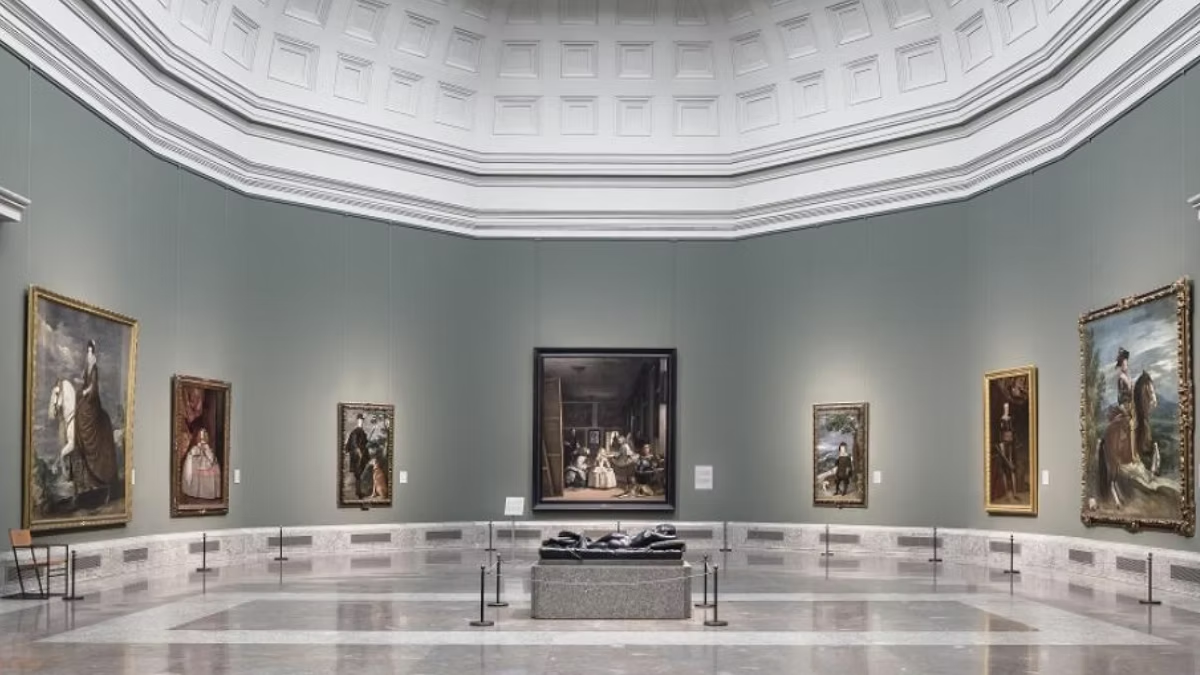
The Prado Museum holds the world’s largest and finest collection of works by Diego Velázquez, with over 50 paintings displayed primarily in Rooms 10–16 on the first floor of the Villanueva Building. Beyond Las Meninas, the collection includes The Surrender of Breda, equestrian portraits of the Spanish royal family, the extraordinary series of court dwarf and jester portraits, Las Hilanderas (The Spinners), and the mythological painting The Forge of Vulcan. Together they constitute the most complete survey of the greatest painter of the Spanish Golden Age.
Everyone comes to the Prado for Las Meninas. Fewer visitors leave having explored what surrounds it — and what surrounds it is extraordinary. The Prado holds more than 50 works by Velázquez, constituting not just the world’s largest collection of his paintings but an education in the full range of one of the three or four greatest painters who ever lived.
Las Meninas is the culmination. But understanding what it culminates requires seeing the work that preceded and surrounded it.
Top Tickets
Who Was Velázquez?
Diego Rodríguez de Silva y Velázquez was born in Seville in 1599 and died in Madrid in 1660. He became court painter to Philip IV of Spain at the age of 24 and held that position for the remaining 37 years of his life — one of the longest, most productive, and most influential careers in the history of European painting.
His relationship with Philip IV was unusually close. The king granted him a studio in the royal palace, gave him access to the royal collections (which included works by Titian, Rubens, and Raphael that Velázquez studied intensively), sent him twice to Italy to acquire works and study the Italian masters, and ultimately granted him membership in the Order of Santiago — the mark of nobility that appears as a red cross on his chest in Las Meninas.
Velázquez’s technical virtuosity was recognised in his own lifetime. His influence on subsequent European painting — particularly on Manet, who called him “the painter of painters” — has been profound and continuous.
The Velázquez Rooms at the Prado
Velázquez’s work is displayed primarily in Rooms 10–16 on the First Floor of the Villanueva Building, with additional works in adjacent rooms. Room 12 is dedicated to Las Meninas; the surrounding rooms contain the rest of the collection, which should be explored as a whole.
The Surrender of Breda (1634–1635) — Room 14
Las Lanzas — The Lances — as this painting is also known, is the great history painting of the Spanish Golden Age and one of Velázquez’s most ambitious works. It depicts the surrender of the Dutch city of Breda to the Spanish general Ambrogio Spinola in 1625 — a Spanish victory in the Eighty Years’ War.
What makes the painting extraordinary is what Velázquez chose not to show. Rather than a scene of triumph and humiliation — the traditional mode of victory painting — he depicts the moment in which Spinola reaches forward to prevent the Dutch commander Justin of Nassau from kneeling in submission. It is a gesture of mutual respect between professional soldiers, acknowledging the dignity of the defeated without diminishing the fact of the victory.
The painting contains approximately forty figures, the forest of Spanish lances that gives it its alternate title, and a landscape of the besieged city in the background. Velázquez places himself among the Spanish soldiers in the right foreground — a discreet self-insertion that predates the more famous one in Las Meninas by twenty years.
What to look for: Spinola’s gesture toward Nassau’s shoulder — the central act of the painting, and the one that makes it morally distinctive. The contrast between the upright Spanish lances and the disordered Dutch weapons. Velázquez among the soldiers on the right.
The Equestrian Portraits — Rooms 12 and 14
The royal equestrian portraits — Philip IV on horseback, Philip III on horseback, Queen Isabel de Borbón, Queen Margarita of Austria, and the young Prince Baltasar Carlos — were painted for the Hall of Realms in the Buen Retiro Palace and constitute one of the great cycles of royal portraiture in European art.
They follow directly from Titian’s Charles V at Mühlberg (Room 27) in their ambition: the monarch alone, dominant, authoritative, placed against a landscape that implies the extent of their domain. But Velázquez brings to them a quality of individuality — particularly in the portraits of the children and the queens — that goes beyond dynastic representation.
Prince Baltasar Carlos on Horseback (Room 12)
The most affecting of the series, painted when the prince was approximately five years old. A child in adult military costume on a rearing horse, commanding a landscape that he will never actually rule — Baltasar Carlos died in 1646 at the age of 17, and with him the direct male line of the Spanish Habsburgs effectively ended.
The Court Dwarf and Jester Portraits — Rooms 15–16
These are among the most remarkable portraits in the Western tradition and among the most consistently overlooked works in the Prado.
The Spanish royal court employed dwarfs, jesters, and fools as companions to the royal children and as figures of entertainment. They occupied an ambiguous position — simultaneously servants and, because of their physical difference, figures invested with a kind of transgressive freedom that those of standard stature could not exercise.
Velázquez painted their portraits with exactly the same attention, dignity, and psychological penetration that he brought to his portraits of kings and queens. He does not mock them, sentimentalise them, or render them as curiosities. He paints them as people.
Don Sebastián de Morra — Seated, his legs extended before him (he was very short), his arms folded, his gaze fixed on the viewer with an expression of complete, slightly challenging dignity. The painting refuses to explain or justify its subject. It simply shows a person.
Francisco Lezcano (El Niño de Vallecas) — A young dwarf, perhaps cognitively disabled, holding a deck of cards, looking away from the viewer with an expression that is at once blank and somehow specific. The landscape background — unusual for an indoor portrait — gives the work a quality of openness that the subject himself appears to be denied.
Don Juan de Austria — Named ironically after the Spanish naval hero, this dwarf is painted in military costume with maps and naval equipment — a visual joke that does not feel like mockery.
Las Hilanderas (The Spinners) — Room 16
Formally titled The Fable of Arachne, this large work depicts a tapestry workshop in the foreground and, in the brightly lit room visible beyond, the moment from Ovid’s Metamorphoses when Athena confronts the mortal weaver Arachne who has presumed to challenge the gods. The painting operates on two levels simultaneously — a scene of contemporary labour in the front, a mythological narrative in the back — and the relationship between the two planes is never fully resolved.
It is Velázquez’s most complex compositional achievement outside Las Meninas and was not fully understood or appreciated until the 20th century, when scholars identified the mythological narrative in the background room.
What to look for: The figure in the foreground left, spinning — the extraordinary naturalism of the spinning wheel, whose spokes blur with movement in a way that anticipates photographic motion blur by 200 years. The brightly lit group in the background, where Athena raises her arm toward Arachne.
The Mythological Works: Vulcan, Mars, Mercury and Argus
Velázquez painted a small number of mythological subjects, primarily during and after his first trip to Italy (1629–1631). These works — The Forge of Vulcan, Mars, Mercury and Argus — are among the most technically extraordinary works in the museum.
The Forge of Vulcan (Room 14) depicts the moment when Apollo informs Vulcan that his wife Venus is being unfaithful with Mars. Vulcan and his assistants — rendered with an extraordinary sense of physical reality, muscular bodies frozen mid-action — turn to hear the news. Apollo is luminous, divine, impossibly beautiful against the workshop’s heat; the workers are human, physical, ordinary. The contrast between divine and human registers of existence is the painting’s central theme.
Mars (Room 12) shows the god of war seated alone, in a state of evident exhaustion or depression, his armour discarded around him. It is one of the strangest mythological paintings of the 17th century — deliberately anticlimactic, almost satirical in its deflation of heroic expectation.
The Religious Works
Velázquez painted relatively few purely religious works compared to his contemporaries, but the Prado holds several significant examples. Christ Crucified (Room 15) — a figure of absolute physical stillness against a black ground — is considered by many scholars to be among the finest crucifixion paintings in the Spanish tradition.
Velázquez’s Self-Portraits
Beyond the famous self-portrait in Las Meninas, Velázquez appears discreetly in The Surrender of Breda among the Spanish soldiers. Several other self-portraits and possible self-portraits are in international collections. The Prado’s holdings allow a sustained reading of how Velázquez constructed his own image across his career.
Seeing the Full Velázquez Collection
Allow at least 45–60 minutes for the Velázquez rooms as a whole — more if you want to read each work carefully. Begin with Las Meninas in Room 12, then work outward through the surrounding rooms. Use the floor map to identify the dwarf portraits in Rooms 15–16, which are frequently skipped by visitors moving quickly toward the Bosch triptych.
For guided interpretation, the masterpieces small group tour and private tour both spend extended time in the Velázquez rooms. The 3-hour private tour is particularly well-suited to visitors who want the full depth of the collection.
Frequently Asked Questions
Where is the Velázquez collection located in the Prado?
The Velázquez collection is displayed primarily in Rooms 10–16 on the First Floor of the Villanueva Building. Room 12 is dedicated to Las Meninas, with the surrounding rooms housing The Surrender of Breda, the equestrian portraits, the court dwarf and jester portraits, and Las Hilanderas.
How long should I spend in the Velázquez rooms at the Prado?
Allow at least 45–60 minutes for the Velázquez rooms, or longer if you want to read each work carefully. Begin with Las Meninas in Room 12, then work outward through the surrounding rooms. Don’t miss the dwarf and jester portraits in Rooms 15–16, which are frequently skipped by visitors moving quickly through the museum.
How many Velázquez paintings does the Prado hold?
The Prado holds more than 50 works by Velázquez, constituting the world’s largest collection of his paintings. The collection spans his full career, from early history paintings and royal portraits to mythological works, religious paintings, and the extraordinary court dwarf and jester portraits.
Is Las Meninas the most important Velázquez at the Prado?
Las Meninas is the most famous, but the Prado’s Velázquez collection extends far beyond it. The Surrender of Breda, the equestrian portraits, Las Hilanderas, and the court dwarf portraits are all considered masterpieces in their own right. Seeing the full collection makes Las Meninas itself more comprehensible as the culmination of Velázquez’s career.
Do I need a special ticket to see the Velázquez rooms?
No special ticket is required. The Velázquez rooms are included in the standard Prado Museum entry ticket and are open during regular museum hours. For a more in-depth experience, guided tours and private tours include extended time in the Velázquez rooms with expert commentary.
