

Rubens & the Flemish Masters at the Prado
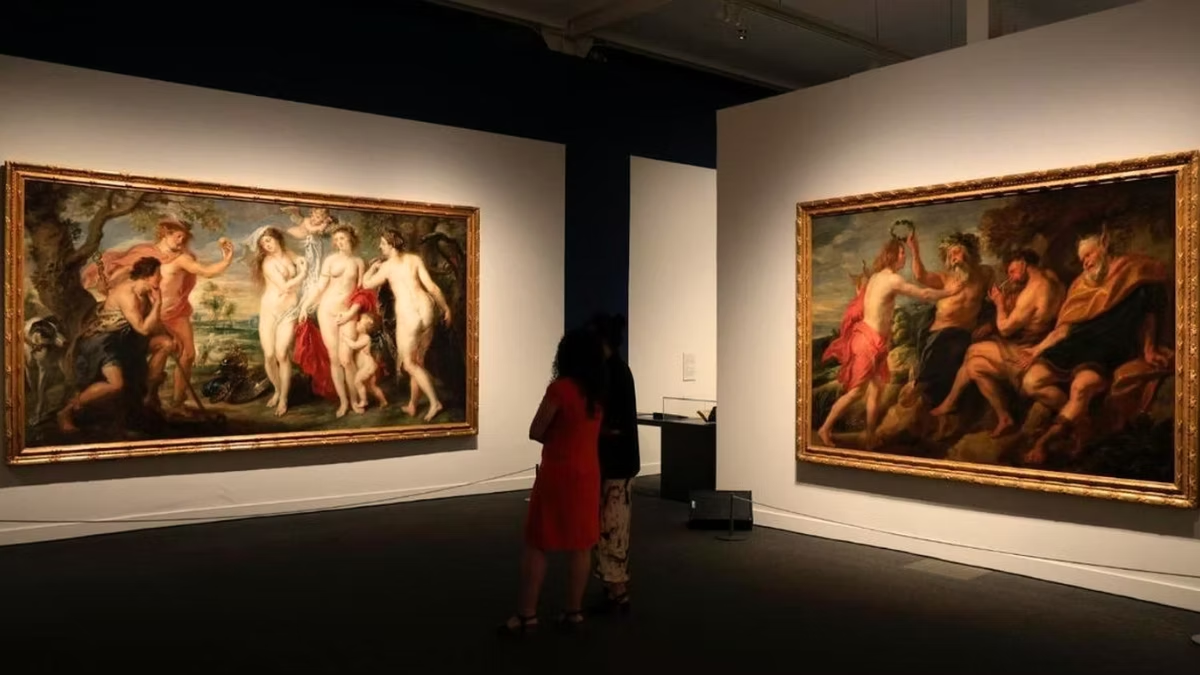
The Prado Museum holds one of the most important collections of Flemish painting outside Belgium, including over 90 works by Peter Paul Rubens. The Flemish collection is displayed primarily in Rooms 28–32 on the first floor of the Villanueva Building. Key works include The Three Graces, The Adoration of the Magi, The Garden of Love, portraits by Anthony van Dyck, and Flemish landscape and genre paintings by Jan Brueghel the Elder and Paul Bril. The collection was assembled by the Spanish Habsburg monarchs through their close political and cultural ties to the Spanish Netherlands.
The Prado’s Flemish collection is one of the three or four finest in the world — a direct consequence of the Spanish Habsburgs’ rule over the Spanish Netherlands and their sustained patronage of Flemish artists from the 16th century onwards. Philip II, Philip IV, and the successive Habsburg monarchs commissioned and collected Flemish painting on a scale that brought extraordinary quantities of work to Spain, where it shaped the development of Spanish court painting — including Velázquez — through close and sustained contact.
At the centre of the collection is Peter Paul Rubens, represented by more than 90 works at the Prado. Around him, the surrounding rooms contain Van Dyck, Jan Brueghel the Elder, Paul Bril, and other figures of the Flemish Baroque who together constitute a complete survey of the greatest painting tradition of the 17th century outside Italy.
Top Tickets
Peter Paul Rubens at the Prado
Peter Paul Rubens (1577–1640) is the central figure of the Flemish Baroque and one of the most prolific and technically accomplished painters in the history of European art. He was also, uniquely, a diplomat — a man employed by the Spanish Crown and the Habsburg rulers of the Spanish Netherlands to conduct sensitive negotiations with foreign powers, using his social access as a celebrated artist to move through courts that were otherwise closed to official envoys.
His relationship with the Spanish Crown was close and sustained across his career. He visited Madrid in 1603 and again in 1628–1629, during which visit he spent eight months at the Spanish court, studied Titian extensively in the royal collection, and had daily conversations with Philip IV. He painted numerous portraits of the king, his family, and the court, and received major commissions for the royal residences.
The result is the largest collection of Rubens outside Antwerp.
The Three Graces (c.1630–1635) — Room 29
The most celebrated work in the Prado’s Rubens collection and one of the most joyous paintings in any museum. Three female figures — the Three Graces of classical mythology, embodiments of beauty, charm, and creativity — dance in a circle, seen from three different angles simultaneously, their arms interlaced and a diaphanous scarf floating between them.
The painting is a technical demonstration of the highest order: three bodies, three viewpoints, a complex spatial relationship between the figures, and the extraordinarily difficult rendering of the scarf — fabric so fine it is almost invisible, caught in the light and in motion. It is also deeply personal. One of the three figures is widely believed to be a portrait of Rubens’s second wife, Hélène Fourment, whom he married in 1630 when he was 53 and she was 16. The painting dates from the early years of that marriage and has a quality of personal celebration alongside its classical programme.
What to look for: The scarf — technically the most difficult element in the painting, requiring the rendering of transparent fabric in motion, which Rubens manages with a lightness that is genuinely astonishing. The spatial relationship between the three figures, which resolves differently depending on where you stand. And the landscape background, which opens the scene into natural light.
The Adoration of the Magi (1609) — Room 29
One of Rubens’s largest and most ambitious religious paintings, executed in the years immediately after his return from Italy and his assumption of the role of court painter to the Archduke Albert and Archduchess Isabella in Brussels. The large format — over 350 cm wide — was appropriate for the commission (it was painted for the Antwerp Town Hall) and allowed Rubens to demonstrate the full range of his compositional abilities: the crowded figural group, the architectural setting, the variety of textures (armour, fabric, fur, skin), and the dramatic lighting from the right.
Rubens repainted and extended the work in 1628–1629, during his stay in Madrid, at the request of Philip IV. The repainted version is what we see today.
The Garden of Love (c.1633) — Room 29
A large celebratory painting of aristocratic outdoor life — elegant figures in a garden setting, attended by cupids and surrounded by architectural and natural abundance. It is understood as an allegory of love and is partly a portrait of the circle around Rubens’s second wife. The painting was immensely influential on 18th-century French painting, particularly Watteau, who cited it as a direct influence on his fêtes galantes.
Self-Portrait with His Wife Isabella Brant (c.1609–1610) — Room 28
One of Rubens’s most intimate and personal works — a double portrait of the artist and his first wife, seated in a honeysuckle bower. The painting dates from just after their marriage in 1609 and has a quality of happiness and ease that makes it unlike most formal portraiture of the period. Their hands are shown touching, though not clasped — a gesture of connection that is specific and human rather than conventionally symbolic.
Mythological Canvases — Rooms 28–29
The surrounding rooms contain major Rubens mythological works — The Rape of Ganymede, Hercules and Cerberus, Nymphs and Satyrs, and others — that demonstrate the full scale and energy of his handling of classical subjects. These are large, exuberant paintings, full of muscular bodies, dramatic action, and a sense of physical abundance that is distinctly Flemish in its appetite for surface and texture.
Anthony van Dyck at the Prado
Anthony van Dyck (1599–1641) was Rubens’s most gifted assistant and successor, and his portraits — in particular his portraits of the English court — defined the visual language of aristocratic portraiture for a century. The Prado holds several significant Van Dyck works, primarily portraits from his period working for the Spanish Netherlands court.
Cardinal-Infante Ferdinand of Austria on Horseback — The younger brother of Philip IV, who governed the Spanish Netherlands as Cardinal-Infante from 1634. Van Dyck’s equestrian portrait combines the Titian template with his own particular sense of elegance and psychological presence.
Self-Portrait — Van Dyck’s self-portraits are among the most consistently fascinating in the tradition — acute, slightly melancholy, always intelligent. The Prado’s example shows him in his middle years.
Jan Brueghel the Elder and the Flemish Landscape Tradition
Jan Brueghel the Elder (1568–1625) — known as Velvet Brueghel for the extraordinary delicacy of his paint surface — worked alongside Rubens on several collaborative paintings and produced an enormous body of landscape, flower, and allegorical works that represent the Flemish tradition at its most refined.
The Prado holds a significant number of Jan Brueghel works, including collaborative paintings with Rubens in which the figures are by Rubens and the landscape or flower elements are by Brueghel — a common practice in Flemish studios, where different specialists contributed their particular skills to a single work.
The Five Senses (Sight, Hearing, Smell, Taste, Touch) — A celebrated series of allegorical paintings produced in collaboration with Rubens, in which each canvas depicts one of the five senses through an accumulation of relevant objects in a richly detailed interior. The series was commissioned by the Archduke Albert and Archduchess Isabella.
Rogier van der Weyden and the Flemish Primitives
The Prado’s Flemish collection extends back before Rubens to the 15th-century painters who defined the tradition he inherited. Rogier van der Weyden’s Descent from the Cross (Room 58) is the outstanding example — arguably the most emotionally devastating painting in the museum outside the Black Paintings, executed with a formal control and psychological intensity that places it among the great works of any century.
See our hidden gems guide for more on the Flemish primitives, which are consistently among the most overlooked major works in the museum.
Why the Flemish Collection Matters at the Prado
The Flemish collection is not simply an appendix to the Spanish collection — it is part of the same story. The Spanish Habsburgs’ sustained engagement with Flemish painting, through the political connection of the Spanish Netherlands and through the collecting instincts of successive monarchs, meant that Velázquez grew up studying Rubens and Titian together in the royal collection, and that the Flemish tradition was absorbed into Spanish court painting at the deepest level.
Understanding the Flemish rooms at the Prado deepens understanding of the Spanish rooms. The equestrian portraits make more sense once you have seen Rubens’s equestrian work. Las Meninas makes more sense once you have seen the Flemish tradition of group portraiture and genre painting that Velázquez was responding to and transforming.
Visiting the Flemish Rooms
Location: Rooms 28–32, First Floor, Villanueva Building — adjacent to the Italian Renaissance rooms (Titian, Raphael) and within easy reach of the Velázquez galleries.
Key rooms: Room 29 is the primary Rubens room, containing The Three Graces, The Adoration of the Magi, and The Garden of Love. Room 28 contains additional major Rubens works and Van Dyck. Room 58 (Ground Floor) contains the Rogier van der Weyden.
How long to spend: 25–35 minutes for the Rubens and Van Dyck rooms. Add 15 minutes for the Jan Brueghel works and 10 minutes for the Rogier van der Weyden if you descend to Room 58.
Frequently Asked Questions
Where is the Flemish collection in the Prado Museum?
The Flemish collection is located primarily in Rooms 28–32 on the first floor of the Villanueva Building. The main Rubens room is Room 29. The Rogier van der Weyden Descent from the Cross is in Room 58 on the ground floor.
How many Rubens paintings does the Prado have?
The Prado holds over 90 works by Peter Paul Rubens, making it the largest Rubens collection outside Antwerp. The collection reflects the close personal and professional relationship between Rubens and the Spanish Habsburg monarchs, particularly Philip IV.
What is the most famous Rubens painting at the Prado?
The Three Graces (c.1630–1635) is the most celebrated work in the Prado’s Rubens collection. Displayed in Room 29, it depicts three female figures from classical mythology and is widely regarded as one of the most technically accomplished paintings in the museum.
How long should I spend in the Flemish rooms at the Prado?
Allow 25–35 minutes for the main Rubens and Van Dyck rooms (Rooms 28–29). Add 15 minutes for the Jan Brueghel works and a further 10 minutes for the Rogier van der Weyden in Room 58 if you wish to cover the Flemish Primitives as well.
Is the Flemish collection included with general Prado admission?
Yes — the Flemish collection, including all Rubens, Van Dyck, and Jan Brueghel works, is included with standard Prado Museum admission. No separate ticket or surcharge is required to access Rooms 28–32 or the Rogier van der Weyden in Room 58.
