

The Prado’s Hidden Gems: Lesser-Known Works Worth Finding
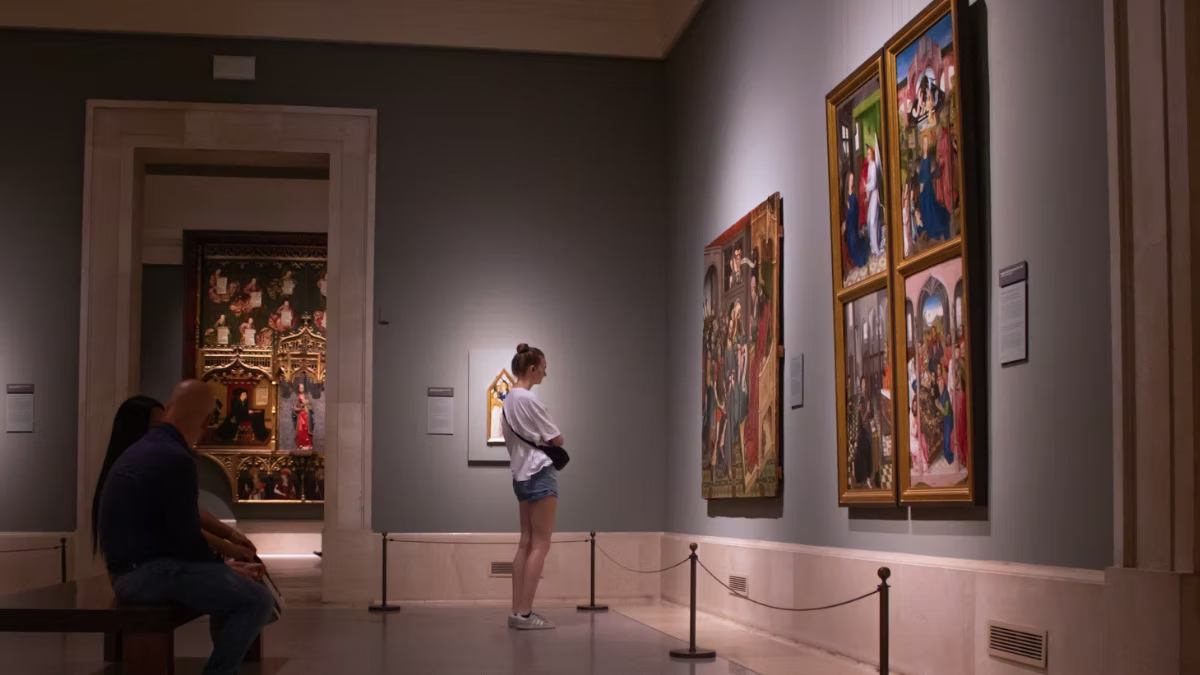
The Prado Museum’s hidden gems — lesser-known works that most visitors overlook — include José de Ribera’s Martyrdom of Saint Philip, the Prado’s exceptional Roman sculpture collection on the ground floor, Rogier van der Weyden’s Descent from the Cross, Francisco de Zurbarán’s religious paintings, Albrecht Dürer’s Self-Portrait, the dwarf and jester portraits by Velázquez, and Goya’s intimate Black Paintings that surround Saturn Devouring His Son. These works often affect visitors as deeply as the famous masterpieces, with far fewer people in the room.
Every visitor to the Prado comes for Las Meninas, Goya’s Black Paintings, and Bosch’s triptych. These are extraordinary works — worthy of every superlative. But the Prado holds 3,000 paintings on display, and the concentration of quality extends far beyond the canonical highlights that fill every guide.
These are the works that reward visitors who are willing to go off the main route — the paintings in rooms that most visitors pass through quickly, the sculptures on the ground floor that almost no one stops for, the portraits that sit in the shadow of more famous neighbours. They are not consolation prizes for people who have seen the highlights. In many cases, they are more moving.
Top Tickets
The Dwarf and Jester Portraits — Velázquez | Rooms 15–16
Just beyond Las Meninas, in rooms that many visitors pass quickly en route from one famous painting to another, hang Velázquez’s portraits of the royal court dwarfs and jesters: Don Sebastián de Morra, Francisco Lezcano (El Niño de Vallecas), Antonio el Inglés, and Don Juan de Austria. These are among the most psychologically complex portraits in the collection.
The Spanish court employed dwarfs and jesters as companions to the royal children and as figures of entertainment — but Velázquez refuses to paint them as curiosities or comic figures. He paints them as human beings in full, with the same unblinking attention he gives to kings and queens. Don Sebastián de Morra, seated with his arms folded and his gaze fixed directly on the viewer, has a dignity that makes the room feel very quiet.
Why most visitors miss them: They are adjacent to Las Meninas, and visitors who have just been in Room 12 tend to move quickly towards Titian and Rubens rather than pausing in the surrounding Velázquez rooms.
The Descent from the Cross — Rogier van der Weyden (c.1435) | Room 58
One of the great paintings of the Northern European 15th century, and one of the most emotionally devastating works in the Prado. Rogier van der Weyden depicts the moment Christ is lowered from the Cross — but the painting’s genius is its compression: the figures are arranged within a shallow golden niche as if carved rather than painted, and the grief of each figure is rendered with a specificity that is almost unbearable.
Mary Magdalene on the far right, whose swooning posture mirrors Christ’s, is particularly extraordinary — a masterwork of the expression of emotion through body language in an era before psychology had a vocabulary.
Why most visitors miss it: The Flemish primitive rooms are on the route to the Bosch triptych but tend to be passed quickly. Van der Weyden does not have the same name recognition as Bosch or Rubens.
Albrecht Dürer’s Self-Portrait (1498) — Room 55B
Dürer painted this self-portrait when he was 27 years old, returning from his first trip to Venice. The painting is a self-conscious statement about the status of artists in Northern Europe — where painters were considered craftsmen — compared to Italy, where they were beginning to be treated as intellectuals. Dürer paints himself as a Venetian gentleman: fashionably dressed, with curled hair, gazing directly at the viewer with an expression of complete self-possession.
The Prado holds two Dürer self-portraits (the other is in Munich). This one is widely considered the more significant — partly for its compositional boldness and partly for its explicit positioning of Dürer as a figure of cultural ambition rather than mere technical skill.
Why most visitors miss it: The Northern European rooms are at the far end of the main floor and are rarely prioritised on a first visit.
The Martyrdom of Saint Philip — José de Ribera (1639) | Room 3
Ribera was a Spanish painter who spent his career in Naples, and his work combines the intense physicality of Caravaggio with a specifically Spanish tradition of unflinching devotional painting. The Martyrdom of Saint Philip is one of his largest and most demanding works — a crowd of figures surrounding the saint as he is prepared for crucifixion, painted with a raw attention to the weight and texture of bodies that is genuinely arresting.
Ribera’s paintings in the Prado are among the finest in the collection and are routinely under-visited. If you want to understand what connects Caravaggio to Velázquez’s realism, spending time in Rooms 2–7 is essential.
Why most visitors miss it: The Italian Baroque rooms are on the ground floor and are less prominently signposted than the first-floor Spanish and Flemish galleries.
Zurbarán’s Still Lives and Religious Works | Rooms 16A–18A
Francisco de Zurbarán is the Prado’s great secret among Spanish masters. His religious paintings — monks, saints, white robes against dark backgrounds — have a sculptural quality unlike anything else in the collection. The surfaces in his paintings feel solid: the cloth is genuinely cloth, the ceramic is genuinely ceramic.
His still life works (a small number survive) are considered among the finest in the Spanish tradition — objects arranged with a clarity and silence that anticipates Cézanne by two centuries. The religious paintings in the Prado’s Zurbarán rooms are equally powerful, particularly The Vision of Saint Peter Nolasco.
Why most visitors miss them: Zurbarán does not have a famous single work that draws visitors to his rooms the way Las Meninas draws them to Velázquez.
The Roman Sculpture Collection — Ground Floor, Villanueva Building
The ground floor of the Villanueva Building contains a significant collection of Greco-Roman marbles from the Spanish royal collection that almost no visitor stops to look at. These include portrait busts, mythological figures, and decorative sculpture that in many cases would be the centrepiece of a smaller museum.
The quality of the collection reflects the breadth of the royal acquisitions that formed the Prado’s nucleus — not just painting but all the arts that the Habsburg and Bourbon monarchs collected over two centuries.
Why most visitors miss it: The sculpture is displayed in the building’s central corridor, which most visitors treat as a transit route between gallery rooms rather than a destination in itself.
Goya’s Small Black Paintings That Surround Saturn
Most visitors who come to see Saturn Devouring His Son focus on that single work — understandably, given its fame — and move on. But the Black Paintings are a series of 14 works, and several of the less famous ones are as remarkable as Saturn.
The Dog — a small painting of a dog’s head emerging from what appears to be a vast, murky darkness — is one of the most affecting images Goya ever made. It is usually interpreted as a metaphor for human isolation and despair, but its power comes from the complete absence of explanation. The dog simply exists, alone, in the dark.
Two Old Men Eating depicts two ancient, emaciated figures eating — one of them apparently a hallucination or a skull. The Fates shows three enormous women above a tiny, helpless human figure. Each of the Black Paintings rewards the same sustained attention as Saturn, and each is different in kind.
Why most visitors miss the less famous Black Paintings: Saturn is so overwhelming that visitors tend to stop there rather than moving through the full series in the adjacent rooms.
The Goya Portraits: The Unknown Sitters | Multiple Rooms
Beyond the famous portraits of Charles IV, Queen Maria Luisa, and the Duke of Wellington, Goya painted a series of works depicting unknown or less-celebrated figures that are among his most intimate and psychologically penetrating. The portrait of the Marchioness of Santa Cruz (Room 38) and the self-portraits Goya produced throughout his career offer a very different image of the artist from the Black Paintings — thoughtful, composed, observant.
Planning Your Visit to Find the Hidden Gems
These works are spread across the museum and require a floor map and some purposeful navigation. The full-day Prado itinerary incorporates several of them into an extended afternoon session. The 3-hour private tour can be specifically tailored to explore the less-visited rooms alongside the masterpieces — this is one of the genuine advantages of the longer private format.
For visitors who want expert guidance to the works that go beyond the standard tour route, asking your guide specifically about the dwarf portraits, the Ribera rooms, and the full Black Paintings series before your visit begins will shape the tour productively.
Frequently Asked Questions
What are the most overlooked works at the Prado Museum?
The Prado’s most overlooked works include Velázquez’s dwarf and jester portraits in Rooms 15–16, Rogier van der Weyden’s Descent from the Cross in Room 58, Ribera’s Martyrdom of Saint Philip in Room 3, Zurbarán’s religious paintings, Dürer’s Self-Portrait in Room 55B, and the lesser-known Black Paintings surrounding Saturn Devouring His Son.
Where are the Velázquez dwarf portraits located in the Prado?
Velázquez’s portraits of the royal court dwarfs and jesters — including Don Sebastián de Morra and Francisco Lezcano — hang in Rooms 15–16, just beyond the room containing Las Meninas.
How many of Goya’s Black Paintings are in the Prado?
Goya’s Black Paintings are a series of 14 works. Saturn Devouring His Son is the most famous, but others — particularly The Dog, Two Old Men Eating, and The Fates — are equally extraordinary and typically far less crowded.
Is the Prado’s Roman sculpture collection worth seeing?
Yes. The ground floor of the Villanueva Building houses a significant collection of Greco-Roman marbles from the Spanish royal collection, including portrait busts and mythological figures. Almost no visitors stop here, making it one of the most peaceful and rewarding spaces in the museum.
How long do you need to explore the Prado’s hidden gems properly?
To explore the less-visited rooms alongside the main highlights, plan for at least a full day. A 3-hour private tour can be tailored to cover the lesser-known works — the dwarf portraits, Ribera rooms, and the full Black Paintings series — alongside the famous masterpieces.
