

Is the Prado Museum Worth It? An Honest Assessment
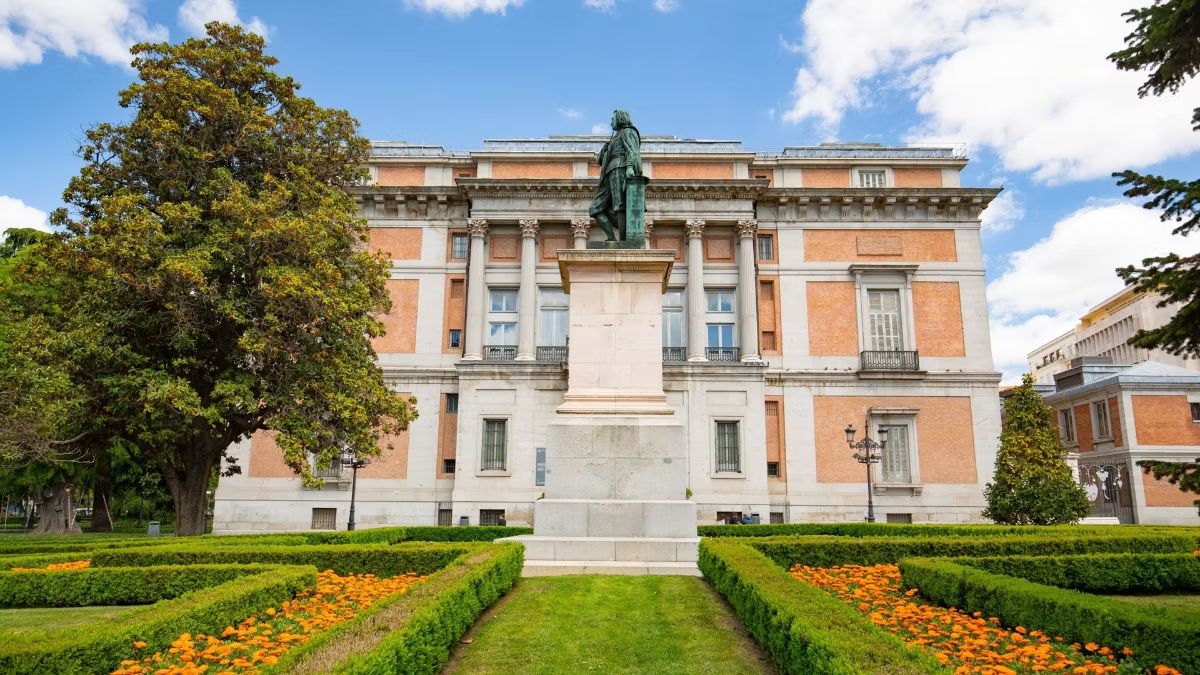
Yes, the Prado Museum is worth visiting for the vast majority of visitors to Madrid. At €15 for general admission — or free during the daily evening window — it offers access to one of the world’s top five art collections, including undisputed masterpieces by Velázquez, Goya, Bosch, El Greco, Titian, and Rubens. It is worth it for art enthusiasts, history lovers, and curious travellers alike. Those with very limited time or no interest in classical European painting may find it less rewarding.
Asking whether the Prado Museum is worth it is a fair question. Madrid has no shortage of ways to spend time and money — Retiro Park, the Royal Palace, Reina Sofía, the Thyssen-Bornemisza, hundreds of restaurants and bars and neighbourhoods worth exploring. Is a visit to the Prado a good use of several hours and €15?
The short answer is almost certainly yes. But the full answer depends on who you are, what you are looking for, and how you approach the visit.
Top Tickets
What Makes the Prado Worth Visiting
The Collection Is Genuinely World-Class
The Prado is not described as one of the world’s great museums as a matter of politeness or tourism marketing. It holds, by broad critical consensus, the finest collection of Spanish painting in existence, the finest collection of Flemish painting outside Belgium, and one of the top collections of Italian Renaissance and Baroque painting anywhere.
The concentration of masterpieces per square metre is exceptional even by the standards of major international institutions. The Louvre, the National Gallery in London, and the Metropolitan Museum of Art in New York all have larger collections — but the Prado arguably has fewer rooms that require apology.
Specific works that make the Prado irreplaceable:
- Las Meninas (Velázquez) — Widely considered the greatest painting ever made. The Prado is the only place you can see it.
- The Garden of Earthly Delights (Bosch) — One of the most extraordinary objects in the history of art. Nowhere else.
- Goya’s Black Paintings — Transferred directly from the walls of Goya’s house. Absolutely unique.
- Saturn Devouring His Son (Goya) — Among the most psychologically intense works ever painted.
- Charles V at Mühlberg (Titian) — The definitive portrait of European imperial power.
- The Three Graces (Rubens) — Joyous, sensuous, technically supreme.
These are not simply famous paintings. They are works that change how you think about what art can do. Seeing them on a screen is not the same.
The Price Is Exceptionally Good Value
At €15, the Prado’s general admission is among the most affordable entry fees for a major international art museum. The Louvre in Paris charges €22. The British Museum is free but accepts donations. The Metropolitan Museum of Art in New York recommends a $30 donation. The Uffizi in Florence charges €20 or more.
For €15, you gain access to the full permanent collection across both buildings and all current temporary exhibitions included. There is no upselling to see the “good” rooms, no additional charge for exhibitions, no queues to specific galleries with surcharges.
And if €15 matters, the daily free entry window (Mon–Sat 6:00–8:00 PM, Sun 5:00–7:00 PM) means the Prado can be visited for nothing at all with the right planning. See the free entry guide.
The Building Itself Is Exceptional
The Villanueva Building — the Prado’s main neoclassical structure — is one of the finest 18th-century public buildings in Spain. The architecture of the museum is not merely a container for the collection: it is part of the experience. The scale, the light, the marble floors, the coffered ceilings, and the painted walls of the upper galleries constitute an environment of genuine distinction.
Book This TourWhen the Prado Might Not Be Worth It for You
If You Have Zero Interest in Classical European Painting
The Prado’s collection spans the 12th century to the early 20th century, with its primary strength in 15th–18th century European painting. There is no contemporary art, no Impressionism (that is at the Thyssen-Bornemisza), no Picasso (that is at the Reina Sofía), and no interactive or multimedia exhibitions.
If classical painting is genuinely of no interest to you, the Prado will feel like a lot of large canvases in a large building. The right question in that case is not whether the Prado is worth it in absolute terms, but whether it is the right museum for you specifically on this trip.
If You Have Less Than 90 Minutes
A rushed visit to the Prado is worse than a focused shorter visit to somewhere else. If you genuinely only have 45 minutes, the Prado’s scale will make it feel overwhelming and unsatisfying. With 90 minutes — particularly if you have done some reading on the major works in advance or book a guided tour — it becomes achievable and memorable.
If You Are Visiting During Peak Crowds Without a Plan
The Prado at midday on a Saturday in August, with no prior knowledge of the layout, no map, and no clear priorities, is a stressful experience. The same museum on a Tuesday morning at 10:00 AM with a plan — or with a guide — is genuinely extraordinary. The visit experience varies enormously with timing and preparation.
The Prado vs Other Madrid Museums: Which Should You Choose?
The Prado Museum, Museo Reina Sofía, and Thyssen-Bornemisza form Madrid’s Golden Triangle of Art. The Prado is best for classical European painting (12th–19th century). Reina Sofía is essential for 20th-century Spanish art, including Picasso’s Guernica. The Thyssen-Bornemisza offers the broadest European collection spanning eight centuries. All three can be visited with the Paseo del Arte Card for around €32.
Choose the Prado if you want the greatest classical European painting collection in Spain, including Velázquez, Goya, Bosch, El Greco, Titian, and Rubens.
Choose the Reina Sofía if you want modern and contemporary Spanish art, and in particular Picasso’s Guernica — the most politically powerful painting of the 20th century.
Choose the Thyssen-Bornemisza if you want the broadest sweep of European art from the medieval period through to the 20th century, including Impressionism, Post-Impressionism, and Expressionism.
Visit all three — and the Paseo del Arte Card makes this financially sensible — if you have two or more days available for Madrid’s museums.
Is a Guided Tour Worth the Extra Cost?
For a first-time visitor, yes — almost certainly. A guided tour of the Prado costs between €25 and €50 per person (above the admission price) but delivers something a solo visit cannot: the context that makes the paintings legible.
Standing in front of Las Meninas knowing nothing about its composition, its subjects, or its art historical significance is interesting. Standing in front of it with a guide who explains what Velázquez was doing with the mirror at the back, who the dwarfs were and what their role in the royal court was, why the artist painted himself into the scene, and how this painting changed the course of European art — that is a different experience entirely.
The guided tour with skip-the-line entry is the most popular single ticket for first-time visitors to the Prado, and it earns that status consistently. The private tour is the best option for those who want a bespoke experience.
Verdict: Is the Prado Museum Worth It?
For the overwhelming majority of visitors to Madrid: yes, unequivocally. The Prado is one of the very few museums in the world where the reality exceeds reasonable expectation. The collection is denser with masterpieces than almost any comparable institution, the admission price is genuinely modest, and the building itself is a pleasure to be in.
Go with a plan. Go when it is not too crowded. If it is your first visit, consider booking a guided tour. And allow enough time — at least two and a half hours — to let the experience breathe.
Frequently Asked Questions
Is the Prado Museum free to enter?
General admission is €15 per adult, but the Prado offers free entry every Monday to Saturday from 6:00 to 8:00 PM and every Sunday from 5:00 to 7:00 PM. Arriving at the start of the free window is advisable as queues build quickly. Under-18s and certain other categories also enter free at all times.
How long does a visit to the Prado Museum take?
Allow at least two and a half hours for a first visit if you want to see the main masterpieces without rushing. Art enthusiasts or visitors on a guided tour may want three to four hours. A 90-minute visit is possible if focused on a handful of highlights, but the Prado rewards time rather than speed.
Do I need to book Prado Museum tickets in advance?
Booking in advance is strongly recommended, particularly for weekend visits and during the summer months of July and August. Walk-up queues at the ticket desk can be long, and timed-entry slots for popular sessions do sell out. Pre-booking also lets you choose your preferred entry time and skip the queue entirely on arrival.
What are the must-see works at the Prado Museum?
The unmissable works are Las Meninas by Velázquez, The Garden of Earthly Delights by Bosch, Goya’s Black Paintings (including Saturn Devouring His Son), Charles V at Mühlberg by Titian, and The Three Graces by Rubens. These are among the most significant paintings in Western art history and can only be seen at the Prado.
Should I visit the Prado, the Reina Sofía, or the Thyssen-Bornemisza?
If you can only choose one, the Prado is the right choice for classical European painting (Velázquez, Goya, Bosch, El Greco). Go to the Reina Sofía for 20th-century Spanish art and Picasso’s Guernica. Go to the Thyssen-Bornemisza for the widest range of European art from the medieval period to the 20th century, including Impressionism. If you have two or more days, the Paseo del Arte Card covers all three for around €32.
